The access platform
This is the part that makes LockerLogic more than a cabinet importer, and the reason a facilities team stops spending its week on lockers. It was not built for this site — it is the same platform running our unmanned equipment cabinets today.
Quick answer: what the platform does
The LockerLogic access platform is the software and electronics that turn a steel locker into a keyless one. A user opens their compartment by scanning the QR code on the door with their phone camera, by entering a PIN on the keypad at the end of the bank, or by tapping an access card the site already issues — there is no app to install. On the administrative side the platform assigns compartments to people, collects recurring locker fees by card, releases day-use compartments automatically at a time you set, applies different access rules to different banks, and logs every opening. Each bank needs one 3-pin socket and reaches LockerLogic over 4G, so no cabling or IT work is required. PIN access continues to work during a network outage, and every compartment has a mechanical master override.
The cycle
From assignment to the rule that ends it. Step four is the one that most locker schemes are missing, and the reason they degrade after six months.
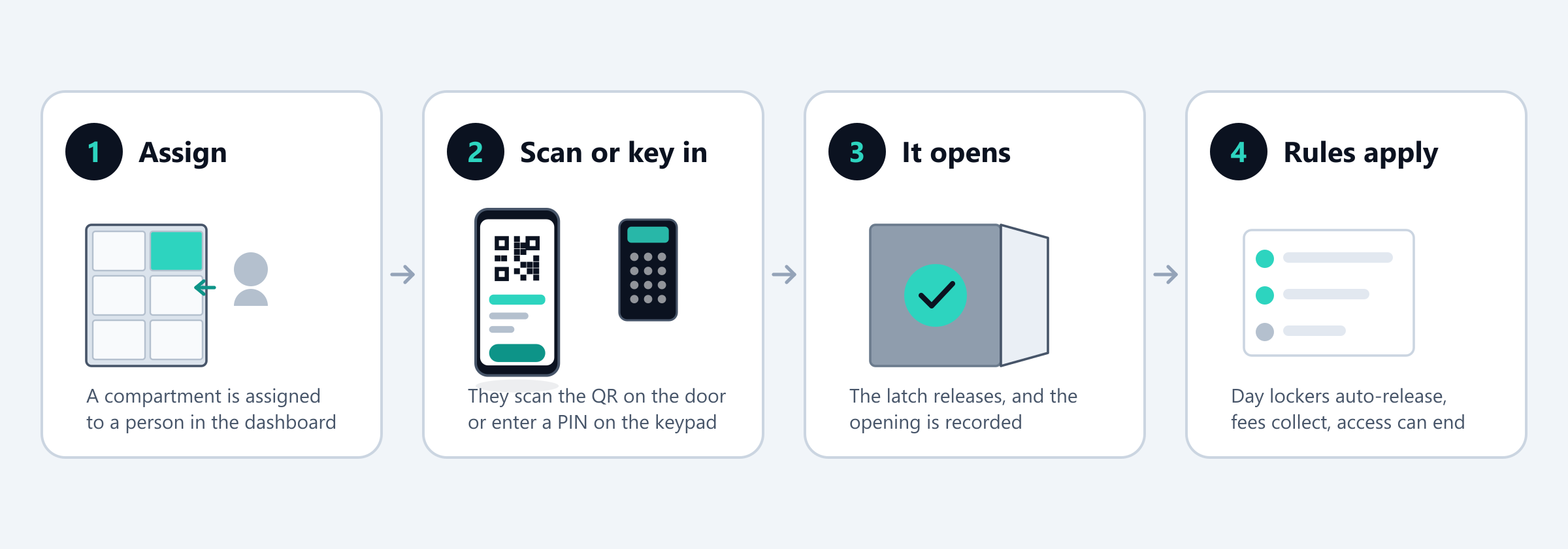
Four ways in
All four can be live on the same bank. A scheme that offers only one method will fail for somebody, and that somebody will be vocal about it.
Scan the QR code on the door
The phone camera opens a page that already knows which compartment it is. If the person holds the assignment, the latch releases. No app to install, no account to create in an app store, no Bluetooth to pair.
Enter a PIN on the bank keypad
A numeric code on the keypad at the end of the bank, for anyone who would rather not use a phone — and as the fallback that keeps working during a network outage, because credentials are cached on the controller.
Tap an existing member or staff card
Where a site already issues access cards, the same card can open a locker. Nothing new goes in anyone's wallet, which removes the most common objection to a new locker scheme.
Remote release by staff
A duty manager opens any compartment from their own phone. A lockout is resolved in seconds without a master key, and a locker that must be cleared is opened with the action recorded against the person who did it.
What it handles for you
Each of these replaces something currently being done by hand, or not being done at all.
Assignment and waiting lists
Assign a compartment to a person, for a period or open-ended. Waiting lists, renewals and transfers are handled in the dashboard, so the locker room stops being administered from a spreadsheet that only one person understands.
Recurring fees collected automatically
Locker fees charged to a card on a monthly or annual cycle through Stripe, with access ending when payment lapses. Nobody has to chase a member for a locker fee, and revenue stops leaking through lockers nobody is billed for.
Time rules and automatic release
Day-use compartments release at closing or after a set number of hours, with a notification to the user first. This single rule is what stops a day-use room silently turning into permanent storage.
Access rules per bank
Open to all verified users, restricted to a member category or department, reserved for staff, or unlisted. Different banks in the same room can carry different rules, and a rule change takes effect immediately.
A log of every opening
Who opened which compartment, when, and by which method. This is what settles disputes about missing belongings, and what makes a cabinet holding personal records defensible rather than merely locked.
Occupancy and utilisation reporting
How many compartments are in use, which have been held longest, and how demand moves through the week. It tells you whether to add a bank or whether you already have too many — a question most sites answer by guessing.
Reminders and overdue handling
Automatic reminders on a schedule you set, a report of the longest-held compartments, and a defined process for release and removal. Without this, a parcel or day-use bank fills up over a few months and quietly stops working.
Charge and condition monitoring
For powered equipment, the platform reports charge state alongside occupancy and can hold a unit back until it is genuinely usable. This is the difference between an unattended equipment scheme that works and one that generates complaints.
The four questions you should be asking
Every experienced facilities manager asks these, and the answers are where most smart-locker pitches quietly fall apart. Ours are here so you do not have to extract them.
A mechanical override on every unit
Electronics fail, and belongings must never be trapped. Every compartment can be opened with a master key held under your control. Any supplier who does not lead with this has not run lockers in the real world.
It keeps working offline
Keypad access continues during a network outage using credentials cached on the controller. New assignments and remote release pause and resume automatically when the connection returns.
One socket, no cabling, no IT involvement
A bank needs a single 3-pin 230 V socket. The controller reaches us over 4G, so there is no structured cabling to pull, no ports to open, and nothing for your IT team to approve. Wi-Fi is supported where you prefer it.
No app for anyone to install
Everything happens in the phone's browser. App installs are where locker schemes lose their least technical users, and those are exactly the members who complain to the committee.
Where this has already been proven
The LockerLogic access platform is not a prototype. It is the same platform that has been running unmanned professional tennis ball machine cabinets at ActiveSG Sport Village @ Jurong Town since day one, under our Tennis Machine SG brand — users book, pay and unlock entirely from their phone, at any hour, with nobody on duty. Applying it to member and staff storage is new, and we would rather say so than imply an installed base we do not yet have.
An unattended cabinet at a public sports centre is a harder test than a members-only locker room: the users are strangers, the equipment is valuable and wheeled away out of sight, the site is outdoors in the tropics, and there is nobody on duty at 6am to sort out a problem. Everything that makes a keyless locker room work had to be solved there first.
Tennis Machine SG →You may not need new lockers at all
If your locker room was refitted in the last few years, replacing the steel is usually waste. A retrofit swaps the cam lock in each door for an electronic latch and adds a controller at the end of the bank — you keep the expensive part and change only the mechanism.
Retrofit usually works when
- The doors are steel, in sound condition, and reasonably rigid
- The existing lock is a standard cam lock in a standard cut-out
- There is a socket within reach of the end of each bank
- The bank layout still suits how the room is actually used
We will tell you to replace when
- The doors are thin-gauge and flex — a latch will not hold alignment
- Corrosion at the base has reached the door frames
- The lockers are timber, or a non-standard proprietary lock
- The compartment sizes are wrong for the room's real use
We survey a sample door before quoting a retrofit. Selling a latch kit that fails in a year costs us the reference, so it is not a corner we cut.
Platform FAQ
Do users have to install an app?
No. The whole flow runs in the phone's browser. A user points their camera at the QR code on the compartment door, the browser opens a page that already identifies that compartment, and if they hold the assignment the latch releases. Requiring an app install is where locker schemes lose their least technical users — and those are precisely the people who then complain to the committee or the front desk.
What happens if the internet goes down?
PIN access keeps working. Credentials are cached on the bank controller, so a user who knows their code gets into their locker whether or not the site has connectivity. What pauses is the online side — new assignments, remote release and reporting — and that resumes automatically when the connection returns. Every compartment also has a mechanical master override, which is the answer when the electronics themselves fail.
What if the electronics fail and someone's belongings are inside?
You open it with the master key. Every unit ships with a mechanical override, and it should be held under controlled custody — ideally in a key cabinet, not in a desk drawer. Any locker supplier who does not lead with this has not run lockers in the real world: electronics eventually fail, and a system that can trap someone's wallet and passport with no way in is not fit for service.
What network and cabling does a bank need?
One standard 3-pin 230 V socket per bank, and nothing else. The controller connects to us over 4G, so there is no structured cabling to pull, no switch ports to allocate, no firewall rules to request and nothing for your IT team to approve — which removes what is often the slowest part of a facilities project. Wi-Fi is supported where a site would rather keep the traffic on its own network.
How much power does it draw?
A few watts standing per bank, comparable to leaving a phone charger plugged in, plus a brief draw each time a latch actuates. Where a bank also charges devices or equipment, the charging load dominates and we will state it for your specific configuration.
Who can see the access log, and what does it record?
Administrators you nominate. Each entry records the compartment, the person holding the assignment, the time, and the method used — QR, PIN, card or staff remote release. That record is what settles disputes about missing belongings, and what makes a cabinet holding personal records defensible rather than merely locked. We can restrict which administrators see which banks.
Can locker fees be collected automatically?
Yes, by card on a monthly or annual cycle, with access ending if payment lapses. This is where most locker schemes leak money: fees invoiced by hand get chased inconsistently and quietly written off. Where you would rather bill through your own membership or gym system, we can export the assignment data for your system to charge against instead.
Is the platform hosted in Singapore, and what data does it hold?
The platform holds the minimum needed to run a locker: who holds which compartment, the access credential, the opening log, and payment records handled by Stripe rather than by us. We are happy to walk your IT or data protection lead through exactly what is stored and where before you commit, and to put it in writing. We would rather answer that question properly at the survey than have it surface after installation.
Can the platform run on lockers we already own?
In most cases yes — a retrofit electronic latch replaces the existing cam lock and a controller mounts at the end of the bank. We survey a sample door first because door thickness and latch geometry decide whether the kit fits reliably. Retrofit is substantially cheaper than replacement and typically takes about a day per room.