- Digital
- Connected (our default specification)
RFID Tool Management Lockers
Every tool signed out to a person, with nobody behind a counter
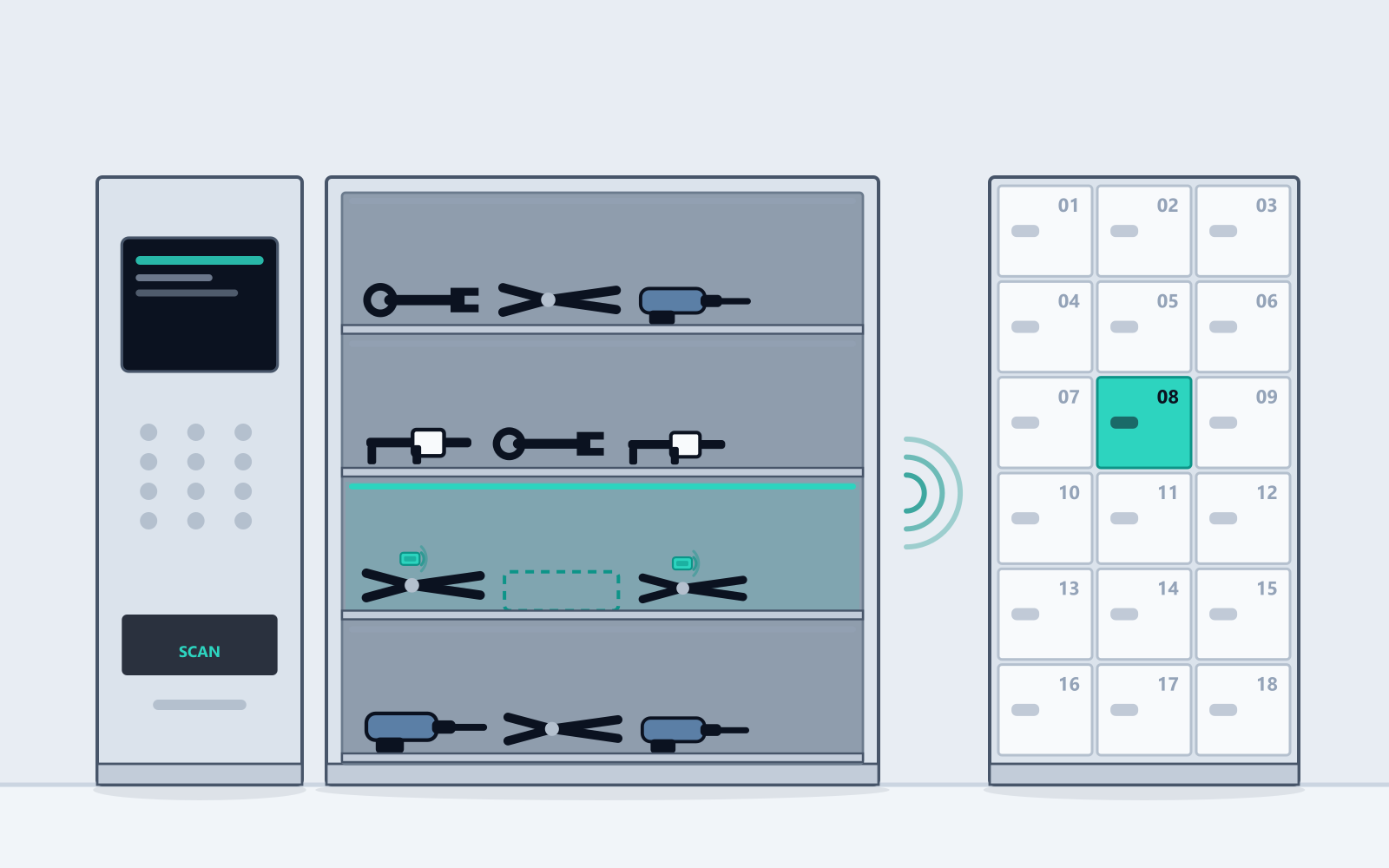
Workshop and production-floor tool cribs where each item carries an RFID tag and the cabinet reads its own contents every time a door closes. Issue and return without a storeman, and a live shortage list instead of a quarterly stocktake.
Lock options
The lock is specified per bank, separately from the cabinet. We would specify connected smart access on this family unless you tell us otherwise.
| Tier | What it means here | Needs | Cost |
|---|---|---|---|
| Digital | Battery keypad, card or fingerprint lock per door. Offline, no wiring, no subscription. | Batteries in each lock, typically replaced yearly. No socket, no cabling, no network, no IT involvement. | Mid — hardware only, no recurring fee |
| Connected Our default here | Electronic latch on the Latchwork platform — QR, PIN, card and remote release, with a full log. | One standard 3-pin 230 V socket per bank. The controller reaches us over 4G, so there is no connection to the site's LAN — no structured cabling, no switch ports and no firewall rules. Wi-Fi is supported where preferred. | Highest — hardware per compartment plus an annual subscription per bank |
What we would recommend, and why
The only family in the range with no keyed option, and that is not an upsell. What you are buying is the record of who holds which tool — take away the identity and the network and it is a cupboard with an aerial in it. If a site wants controlled access without tracking, we quote a keypad bank from the equipment or changing families instead, and say so plainly.
Compare the lock options →Standard configurations
These cover the large majority of enquiries and are the fastest and cheapest route to a delivered installation. Anything here can also be made to a different size.
| Configuration | Compartments | W × D × H (mm) | Notes |
|---|---|---|---|
| Single-bay tool crib | 4–6 shelves | 900 × 500 × 1850 | One antenna per shelf, integrated terminal — the smallest unit that stands alone on a shop floor |
| Twin-bay crib with terminal column | 8–12 shelves | 1800 × 500 × 1850 | Terminal in its own column so both bays stay full-height storage |
| Drawer cabinet, tagged per drawer | 6–9 drawers | 900 × 600 × 1200 | Foam-cut drawer inserts, one antenna per drawer — for sets that must stay complete |
| Calibrated instrument cabinet | 12–24 cells | 900 × 450 × 1850 | Per-cell doors, so an instrument past its calibration date can be locked shut on its own |
| Heavy and long tool bay | 2–4 bays | 900 × 700 × 1850 | Full-height bays for cutting gear, breakers and long-reach tooling, on a load-rated base |
| Consumables dispensing column | 10–20 cells | 600 × 450 × 1850 | Issue-only cells for inserts, drills, blades and gloves — counted out, not expected back |
Dimensions are stated as width × depth × height in millimetres throughout this site. Factory drawings often mix conventions, so confirm against the dimensioned drawing issued with your quotation before any builder’s work is committed.
Made to order
A crib is designed from the tool list, not from a cabinet size. Send the schedule of what is held, how many of each, which items are calibrated and which are consumable, and we come back with a bay layout, a tag specification and an antenna plan. Metal-dense tooling and a bay full of steel both affect read reliability, so the layout is engineering rather than styling.
Construction & specification
- Passive UHF RFID antenna behind every shelf, drawer or cell, on a shielded reader in the controller column
- On-metal UHF tags rated for oil, coolant, swarf and solvent wash — epoxy, cable-tie or screw-fixed to the tool
- Electronic latch per door with mechanical override, and a battery keypad variant where there is no network
- Touchscreen terminal at the bank: card, PIN or QR sign-in, showing the issue list back before the door unlocks
- Steel body with load-rated shelves; stainless where the crib sits in a wash-down or coolant-heavy area
- Mains power with a UPS, on Ethernet or 4G — the crib keeps issuing and logs locally through a network outage
What goes in them
- Torque wrenches, gauges and calibrated instruments
- Power tools and battery packs on charge
- Cutting tools, inserts, drills and blades
- Jigs, fixtures and change-over tooling
- Test meters, thermal cameras and endoscopes
- Issued PPE and shift consumables
Available on our smart platform
Electronic latch on the Latchwork platform — QR, PIN, card and remote release, with a full log.
How the platform works →Who specifies these
The cabinet barely changes between these. What changes is the compartment mix, the access rules and who administers it — so it is worth reading the page written for your situation.
Quick answer: RFID tool management lockers in Singapore
Latchwork builds RFID tool management lockers in Singapore for factory workshops, MRO stores and production lines. Each tool carries a rugged UHF RFID tag, an antenna behind every compartment reads the contents when the door closes, and the difference is posted to the platform as an issue or a return against whoever opened it. The crib runs unmanned across every shift, and a missing tool is known in seconds rather than at the next stocktake.
- Standard sizes
- 6 listed
- Lock options
- Digital, Connected
- We specify
- Connected
- Lead time
- 6–10 weeks
Tool management — questions we get asked
How does the cabinet know a tool has gone without anyone scanning it?
It reads the compartment rather than the item. The user signs in at the terminal, the latch releases, and when the door closes the antenna behind that shelf takes a fresh inventory of every tag it can see. Anything that was there before and is not there now is an issue against that person; anything new is a return. Nobody points a scanner at anything, which matters — a process that depends on a technician remembering to scan is a process that stops working in week three.
Do RFID tags actually read reliably on metal tools?
Only with on-metal tags, and that is the single most common reason these systems fail. A plain adhesive label mounted on steel detunes and reads intermittently, which is worse than no system at all because the shortage report then cries wolf. We specify on-metal UHF tags, set antenna power per shelf against the real tool mix at commissioning, and tell you where a tool is too small or too dense to tag reliably — those go in a per-cell compartment, where the door position is the record instead.
What happens if the network drops mid-shift?
The crib keeps working. Sign-in, unlocking and inventory all run on the controller at the bank, and events queue locally and sync when the link returns. That is deliberate: a tool store that stops issuing because a switch rebooted takes a production line down with it. The only thing that waits for the network is a change you make centrally, such as revoking a leaver.
Can it stop someone taking a tool that is out of calibration?
Yes, and on most sites this is the feature that pays for the system. Calibration dates are held against the tag, so an instrument past its date is locked shut on a per-cell cabinet, or refused on the sign-out list and flagged to the supervisor on a shelf bay. The same rule covers tools issued only to trained users and tooling that must not leave a particular line.
How is this different from a vending machine for tools?
A vending machine dispenses and expects nothing back, which is right for inserts and gloves and wrong for a torque wrench. This is a returnable-asset system: the same tool goes out and comes back many times, and what matters is who holds it now and for how long. We build both in one bank — dispensing columns for consumables, tracked bays for durable tooling — because most workshops need both, and buying two systems is how the data ends up in two places that disagree.
What does it take to run day to day?
Tagging new tools as they arrive, and acting on the shortage report. That is the honest answer. The system removes the storeman and the stocktake; it does not remove the need for somebody to own the tool list. Where a site has nobody willing to own it we say so before quoting, because an unowned crib degrades into an expensive cupboard inside a year.