Built to your wall · 6–10 weeks
Phone lockers, made to order
Two things we fabricate rather than stock: a charging bank built to your opening at roughly two and a half times the bays per metre, and plain high-density steel cells with a socket in every one, some, or none.
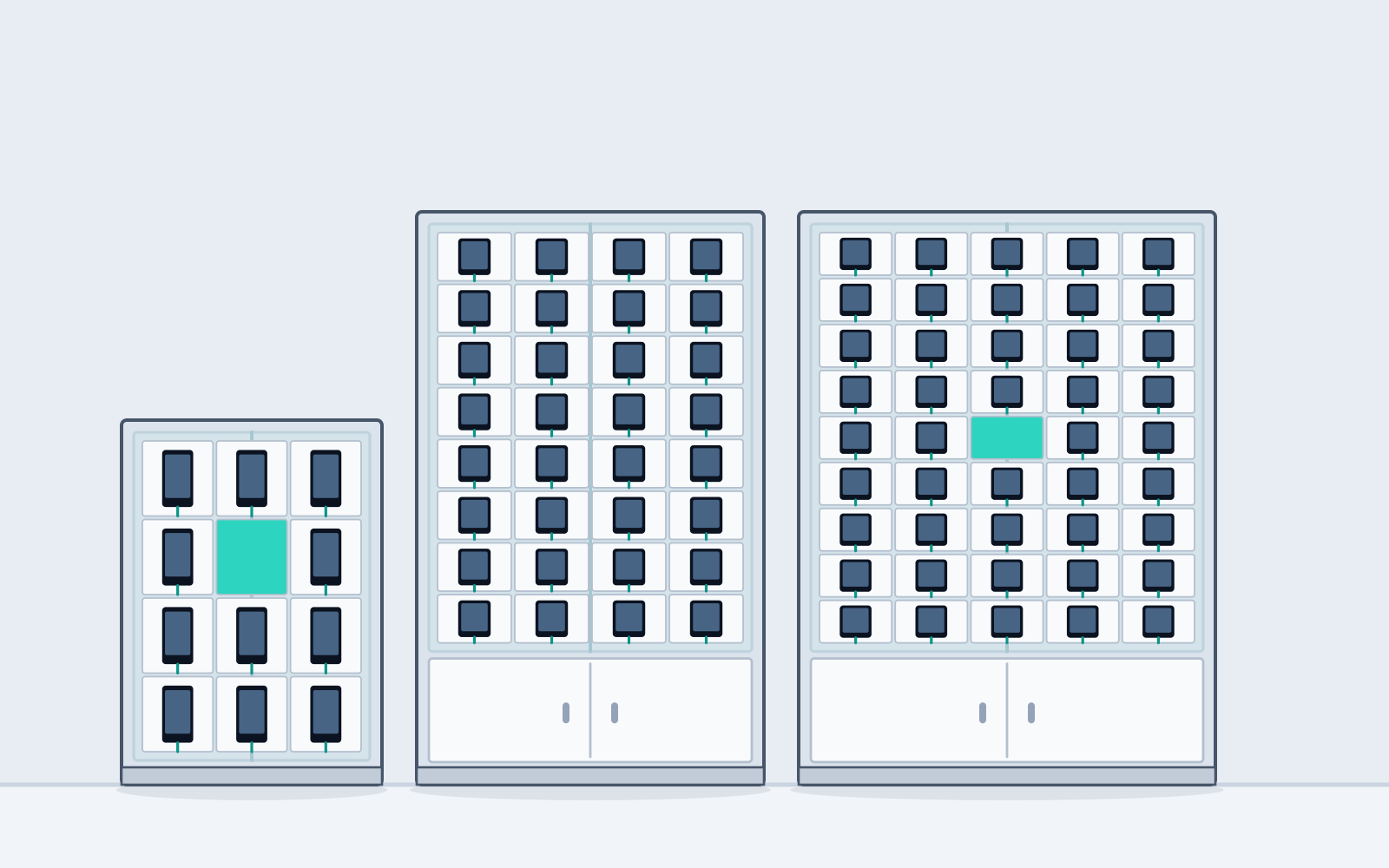
Want one off the shelf instead?
11 catalogue models, 6 to 32 bays, with a lead time from two weeks.
Built to your opening
Built to a Latchwork drawing rather than picked from a catalogue: fifty bays in a 400 mm square tower, banked to whatever total you need. Two and a half times the compartments per metre of wall that the production models manage, purely mechanical locks, and a full-height rear door so all fifty cables can be changed without dismantling anything. This is what we quote when the count is large and the wall is not.
The figure that usually decides it
Two hundred bays needs about 4.1 m of wall in catalogue models stacked two high, or 7.2 m in a single row. The same two hundred made to your opening needs 1.66 m. If you have the wall, buy off the shelf and have it in a month. If you do not, that gap is worth waiting for.
What it gives you
- Around two and a half times the bays per metre of wall
- Exactly the count you asked for, with no surplus capacity to pay for
- Purely mechanical locks — nothing to update, nothing to subscribe to
- Every cable replaceable from the rear without taking the bank apart
- Colour, finish and branding matched to the fit-out
What it costs you
- Eight to ten weeks — the top of our six to ten week made-to-order range, because tooling and a first-article sample come first
- A first production run, so a prototype sign-off stage is unavoidable
- No touchscreen and no voice guide — instructions are a printed panel
- More capacity later means another run, not another unit off a shelf
- Needs about 600 mm of clearance behind it for the maintenance door
CL-MTO specification dimensions, output, locking
| Bays | 40 to 50 per unit, banked to any total |
|---|---|
| Unit size, W × D × H mm | 400 × 400 × 1800 per unit, standing flush side by side |
| Bay size, W × D × H mm | 185 × 250 × 52 |
| What the bay takes | Any phone including a case, laid flat, with its charging head alongside |
| Charging output | 5 V / 2 A per bay, each port independently current-limited |
| Cables | A 3-in-1 cable per bay on a quick-release grommet — the cable is locked in both directions and swaps out in about ten seconds from the rear |
| Locking | None. Mechanical combination dial per door, with a master key override on every one |
| Power | About 500 W per unit, on a standard 13 A wall socket. No switchboard work. |
| Weight | About 20 kg per unit — two people can carry it into a goods lift |
Where this is the wrong answer read before committing
This is a first production run, not a stock item — eight to ten weeks, the top of our six to ten week made-to-order range, with tooling and a sample to sign off before it exists, against a lead time from two weeks for a production model. Adding capacity later means another run rather than buying one more unit. And the rear maintenance door means the bank cannot sit hard against the wall: it needs about 600 mm behind it, or brake castors so it can be pulled forward.
Or just cells, with or without power
Half the enquiries that reach this page do not want a charging locker at all — they want phones out of an examination hall, a clean room or a production floor. A bank of small locked steel cells with no electronics in it is substantially cheaper and solves that completely.
| Configuration | Compartments | W × D × H (mm) | Notes |
|---|---|---|---|
| 12-compartment | 150 × 150 mm cells | 610 × 350 × 810 | Desktop or wall-mounted |
| 24-compartment | 150 × 150 mm cells | 780 × 350 × 1150 | |
| 30-compartment | 150 × 150 mm cells | 950 × 350 × 1150 | |
| 40-compartment | 150 × 150 mm cells | 950 × 350 × 1850 | With a full-width lower cabinet for chargers and cables |
| 50-compartment | 150 × 150 mm cells | 950 × 350 × 1850 | |
| 60-compartment | 150 × 150 mm cells | 1120 × 350 × 1850 | |
| 84-compartment | 154 × 126 mm cells | 1300 × 350 × 1850 | Highest density — phones only, no cases |
Dimensions are stated as width × depth × height in millimetres throughout this site. Factory drawings often mix conventions, so confirm against the dimensioned drawing issued with your quotation before any builder’s work is committed.
How they are built
- Cold-rolled steel body with toughened glass or solid steel doors, specified per cell row
- Five-hole 230 V socket per compartment as standard; USB-A and USB-C outlets on request
- Residual current protection on the supply, with per-row circuit separation
- Individually locked cells — keyed, battery keypad, card, or connected to the Latchwork platform
- Numbered door plates and an acrylic keypad panel
- Glass doors let staff confirm at a glance that a device is present and charging
What goes in them
- Staff and visitor phones in restricted areas
- Student phones during examinations
- Pooled tablets, radios and scanners
- Bodycams and two-way radios between shifts
- Power tool batteries on charge
- Wallets, keys and small valuables
Cell sizes, sockets and larger counts what is configurable
72 and 84-compartment layouts and non-charging variants are standard, and cell size can be enlarged for tablets, radios, barcode scanners or power tool batteries. Specify whether you need a socket in every cell or only in some — it changes the price meaningfully. Larger counts are met by standing banks flush side by side, or by making one bank to the exact width and height of your opening; if you have a wall dimension and a ceiling height, the wall planner will tell you how many cells fit before you call.
Which lock to put on them keyed, keypad or connected
The cell lock is specified independently of the charging. Keyed cells are cheapest and are fine for an examination hall run by an invigilator with a key ring. Keypad cells suit a reception where users lock their own phone away. Connected cells are for pooled devices that must be signed out, accounted for, and held back until actually charged.
How many cells fit on your wall?
The height limit rules banks out more often than the wall length does — these cabinets are 1800 to 1850 mm tall. A 2 m wall takes 100 cells at full height and 60 under a 1.8 m limit.
Open the wall plannerQuick answer: made-to-order phone lockers
Latchwork makes phone lockers to order in Singapore: high-density steel cell cabinets of 12 to 84 individually locked cells per bank, with a 230 V socket in every cell, in the lower rows only, or in none at all — the cheapest way to get phones out of an examination hall or off a production floor. Charging cabinets built to your opening hold about fifty bays in a 400 mm square tower. Catalogue charging models are in the standard product range.
- Cells per bank
- 12 to 84
- Custom bays
- 40–50 per tower
- Density
- ~125 bays per metre
- Lead time
- 6–10 weeks
Made-to-order phone lockers — questions
Which lock makes sense on a plain phone cell cabinet?
It follows who holds the key to the room, not the value of the phones. An examination hall where an invigilator locks a cabinet and unlocks it an hour later wants keyed cells — anything cleverer is cost with no purpose. A reception or production entrance where each person stows their own phone wants keypad cells, so nobody is holding anyone else's property. Pooled devices that leave the building — radios, scanners, bodycams — want connected cells, because the question that eventually gets asked is who had unit 14 on Tuesday, and only connected access can answer it.
How many plain phone cells fit on my wall?
On a standard 1850 mm bank, roughly 50 cells per metre of wall, or up to 65 per metre in the high-density layout for bare phones. Under a low ceiling the figure drops sharply, because every one of our high-capacity cabinets is 1850 mm tall: the tallest that clears a 1.8 m limit is 1150 mm and carries 30 cells in 950 mm, so a 2 m wall takes 60 under that limit against 100 without it. That gap is the single most common surprise in a phone locker enquiry, so the wall planner works it out for you — enter your wall width, your height limit and how many phones you need, and it returns the standard banks that fit and what a bank made to your exact opening would hold.
We need 100 or 200 phone lockers. Is that one cabinet or several?
Several banks standing flush side by side, almost always. The largest single standard bank is 84 cells in 1300 mm of wall, so 200 cells is about 3.6 m of wall where the full 1850 mm height is available. Where it is not, the arithmetic changes completely: under a 1.8 m limit the same 200 cells need roughly 6.5 m in standard cabinets, or about 3.5 m as banks fabricated to the opening — which is usually the point at which custom fabrication pays for itself. Counts at that scale are also worth splitting across two or three locations rather than one long run — a lobby, a floor entrance, a canteen — because it puts the cells where people already stop. Send the wall dimensions for each location and we will lay the whole count out across them.