School Locker Tender Specification: What Should You Include?
Write a comparable school locker tender brief in Singapore: compartment sizes, lock operations, installation, drawings and handover checks.
By Latchwork Published 5 min read
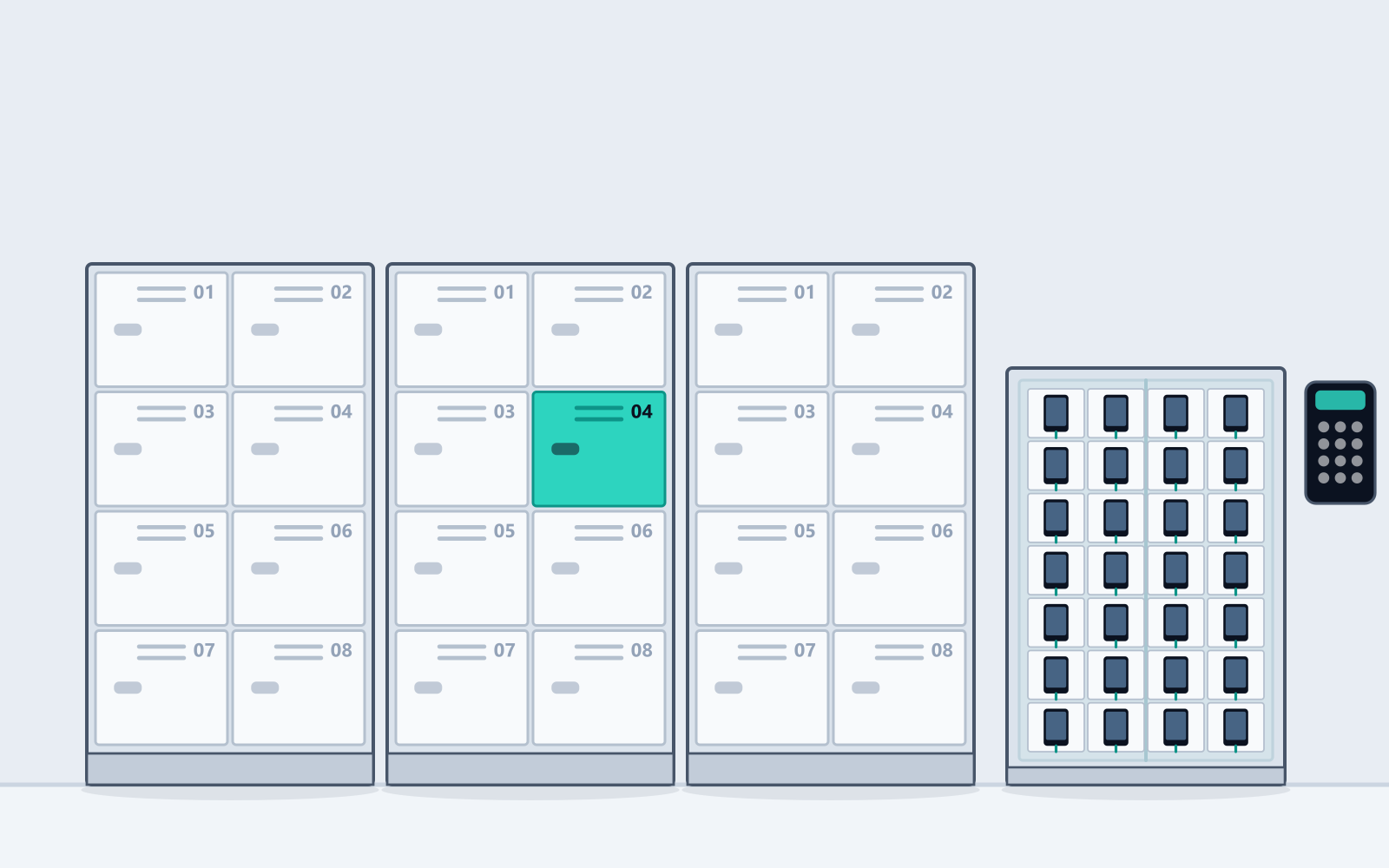
A useful school locker tender describes what must fit, how each bank will be used and what the supplier must prove at handover. “Supply 200 steel lockers” leaves bidders to make different assumptions about doors, clear space, locks and installation. A comparable brief gives every bidder the same schedule and asks them to mark any exception plainly.
Begin with the users and stored items
Split the requirement into student belongings, controlled phone storage, staff belongings and any records or shared equipment. These are not necessarily the same product. A student may need a bag, books and a jacket for the day; an examination phone cabinet may need only small cells under staff control. A records cabinet may need restricted access and a record of opening. The school and campus overview shows why these different uses belong in one plan but not in one undifferentiated door count.
For each group, write down the largest item including its case, the number of simultaneous users, whether anything stays overnight and who is allowed to open a compartment. Count usable compartments, not just pupils on a roll. If a group shares day-use storage, state the intended turnover rule; if each student holds a locker for a term, state how assignments are changed and how a compartment is cleared between holders. These operating questions decide the lock long before a catalogue picture does.
| Requirement | Student corridor locker | Phone collection cabinet | Staff or records cabinet |
|---|---|---|---|
| Size evidence | Clear space for the largest bag, books or kit | Clear cell for the cased device; decide whether charging is needed | Clear space for files, equipment or staff kit |
| Typical holder | Named student or a defined day user | Student, or an invigilator controlling the bank | Named staff member or authorised group |
| Lock decision | Key, local battery PIN, or centrally assigned access | Keyed cells for staff collection, or PIN for self-service | Keyed for ordinary storage; consider logged access where an opening record is required |
| Handover test | Assignment, normal opening and staff override | Device fit, numbering and collection process | Permission and recovery process |
This is a planning table, not a claim that any one configuration suits every school. The tender should let bidders explain an equivalent arrangement while keeping the operational result testable.
Specify clear internal space as well as the cabinet envelope
The school should state both a minimum usable compartment width × depth × height and the maximum overall cabinet dimensions allowed at each location. An external size can hide wasted space behind a frame, shelf or lock. Conversely, an internal size without a site envelope can produce a bank that blocks a door or cannot be carried through the lift. Latchwork records dimensions in width × depth × height order; make the order explicit in the tender and require bidders to use the same convention.
Ask for a bank schedule by location: quantity, doors per bank, clear compartment size, overall width × depth × height, intended stored item and door numbers. Measure the usable wall at several heights, the floor fall, ceiling and overhead obstructions, skirting, services, door swing and route from loading point to final position. The site-survey checklist explains why a wall-width calculation is only an initial layout. Require a dimensioned drawing to be approved before fabrication, especially for a made-to-order bank.
Write the lock operation, not just “digital lock”
For most ordinary school corridors, Latchwork’s standalone battery keypad option removes the key-handling problem without a socket, cabling or platform subscription. Staff still administer each lock locally. If a school wants to reassign a whole year group centrally or needs an opening log, specify connected access and the associated controller, power, administration and recurring service instead. A keyed lock may be simpler for an invigilator-controlled phone cabinet. These are distinct price and operating models, so a tender that says only “electronic lock” is not comparable.
Define who issues a credential, who can override a forgotten code, what happens when a student leaves, and how a locker is proved empty before reassignment. For a connected bank, ask bidders to demonstrate bulk assignment, revocation, staff release and the agreed access record. For standalone locks, ask how a caretaker resets a code at the door and who holds the mechanical override. The access comparison separates local PIN, RFID and connected access; a card reader on its own should not be mistaken for central administration.
The same distinction applies to phone storage. Latchwork’s made-to-order phone cabinets can be specified with sockets in every cell, selected rows or no cells. If the requirement is simply to hold phones during lessons, do not pay for a powered bank by default. If devices must charge, identify which devices, their cases and connectors, the number of powered cells, available site power and who maintains the cables. The phone cabinet range makes the storage-versus-charging choice explicit.
Make construction and installation inspectable
Specify the material and finish for the actual environment, rather than copying a generic gauge into every tender. In a dry corridor, a powder-coated steel cabinet may be appropriate; in a regularly wet or heavily cleaned position, ask the supplier to justify the finish, base detail and ventilation. State whether doors need ventilation, shelves or hanging rails, whether a plinth or legs are preferred for cleaning, and how numbers and labels will be fixed. Request a sample door or finish when colour and touch points matter. Do not treat a decorative rendering as a dimensioned manufacturing drawing.
Installation is part of the scope. The brief should identify delivery hours and route, protection of finished floors, removal of packaging, fixing and levelling, any electrical work, training and making good. Ask for the proposed fixing detail and what the school must provide. If a welded bank cannot pass the lift or stairs, a knock-down option may be needed; Latchwork’s changing-room range includes one for restricted access routes. Decide this before an order is placed, not when a cabinet arrives at the loading bay.
Set acceptance checks before comparing bids
Ask every bidder to return a marked-up compliance schedule against the same drawing and requirements, with exceptions and optional upgrades separately priced. At handover, count the installed doors; check overall and clear sizes against the approved schedule; open and close every door; test each normal lock and staff override; check numbering, keys or programming credentials, fixing, finish and any power arrangement. Receive operating instructions, a maintenance contact and the agreed warranty documentation. A connected bank should additionally demonstrate the assignment, revocation and recovery steps using test users, with no real student details required.
The locker quotation guide helps compare commercial exclusions after the technical schedule is fixed. Send Latchwork the site measurements, stored-item examples, bank schedule and desired lock workflow through the quotation form. Request one dimensioned base proposal and separately priced alternatives for any lock or charging upgrade, so the school can compare like with like rather than guess what a low per-door price omitted.
Where this applies
Quick answer: What should a Singapore school include in a locker tender specification?
A Singapore school locker tender should define what students will store, the required clear compartment size and count, the site layout, construction and finish, lock workflow, installation scope, and handover evidence. Separate ordinary student lockers from phone cabinets and records storage because their users and access rules differ. Require dimensioned drawings and a door-by-door schedule before manufacture, then compare bids against the same acceptance checks rather than a headline price per door.
- Start with
- Items and clear internal size
- Lock decision
- Keys, local PIN or connected
- Drawing
- Approve before fabrication
- Handover
- Test every door and override
Questions people also ask
Should a school specify one lock type for every locker?
A school should specify the lock by workflow, not require one type across every bank. Standalone battery PIN locks can suit ordinary student corridors without wiring or a subscription; keyed cells can suit invigilator-controlled phone storage; connected access is worth considering where a whole cohort needs central reassignment or opening records are required.
Should the tender list cabinet dimensions or clear compartment dimensions?
A school locker tender should list both the maximum overall bank dimensions that fit the site and the minimum clear space inside each compartment. An outside measurement alone does not prove that a bag, helmet or cased phone fits after shelves, hinges and the lock are installed.
What should a supplier show on the approval drawing?
A school should request a dimensioned elevation and plan showing each bank, door count, clear compartment sizes, numbering, lock position, door swing, plinth or legs, fixing points and any power route. The approved drawing should resolve site obstacles and the delivery route before the supplier fabricates the cabinets.
Do school phone storage cabinets need charging sockets?
A school phone cabinet does not need a socket in every cell if the requirement is secure storage during lessons or examinations. Ask for unpowered cells by default and specify powered rows only where devices must actually charge; the electrical scope, access to cables and protection arrangement then belong in the tender.
What should the school test before accepting the lockers?
A school should check the installed count and approved dimensions, open and close every door, test the normal lock and staff override, verify numbering and keys or programming credentials, inspect fixing and finish, and receive operating and maintenance instructions. Any connected bank should also demonstrate the agreed assignment and recovery workflow.