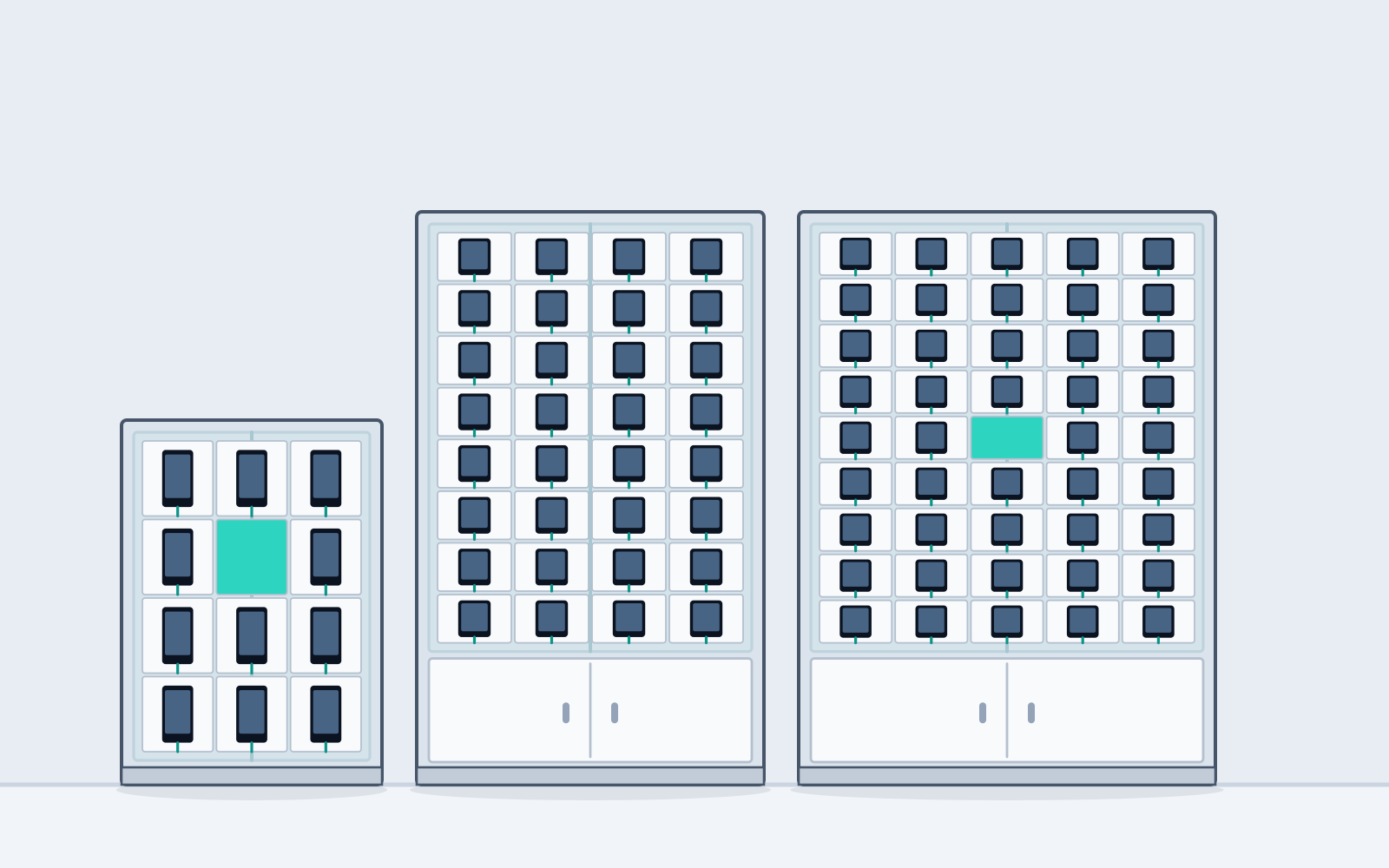
For most secondary schools, the right phone locker for MOE’s school-hours smartphone rule is a bank of plain steel phone cells: individually locked, sized for a phone, and usually without charging. Charging lockers are built for devices that are used and returned through the day, which is not what a school-day phone store does. The decisions that matter are the lock, where the banks go, and how much wall they need.
This guide covers what MOE’s guidelines actually say, how plain phone cells compare with charging lockers, which lock suits which arrangement, and how to work out the count and the wall space.
What MOE’s rule actually requires
From January 2026, secondary school students may not use smartphones or smartwatches during school hours, and that includes recess, co-curricular activities and supplementary, enrichment and remedial lessons. MOE’s announcement says students’ devices “will be kept in designated storage areas (e.g. lockers) or school bags during school hours”, and that schools may allow use by exception where necessary.
So lockers are one of two storage options MOE names, not a mandate. The case for lockers over bags is simple: a phone in a school bag is still within reach, and a locked store puts responsibility in a clear place. What follows applies to schools that have decided on lockers.
Plain phone cells or charging lockers?
A school storing phones for the school day needs plain phone cells; charging lockers solve a different problem. The difference shows up most in how much wall each one takes:
| Plain phone cells | Catalogue charging lockers | Charging cabinet built to your opening | |
|---|---|---|---|
| What it is | Steel cabinet of small individually locked cells | Self-contained unit with a charging cable in every bay | Towers of charging bays fabricated to the wall |
| Capacity per metre of wall | About 50 cells, up to 65 for bare phones | About 30 bays | About 125 bays |
| Charging | Socket in every cell, some rows, or none | Built in | Built in |
| Locks | Keyed, keypad or connected | Touchscreen PIN, keypad, key or fingerprint | Mechanical combination with master key |
| Lead time | 6–8 weeks, made to order | Stock dependent | 8–10 weeks |
| Best for | Storing phones for a school day | Public charging points, libraries, staff areas | Very large counts on a short wall |
Phones stored in the morning and collected at the end of the day rarely need charging, and a socket in every cell changes the price meaningfully. If some charging is wanted, powering only the lower rows is a legitimate saving. Decide before fabrication, though: adding sockets later means opening a live bank and pulling a circuit through a fitted-out room. The phone cell cabinet page lists every configuration.
Choose the lock by who holds the key
The lock on a phone cell should follow who locks and unlocks it, not the value of the phones:
- Keyed cells suit a bank a teacher locks at the start of the day and unlocks at the end. They are the cheapest option, and the same arrangement works for invigilated examination halls.
- Battery keypad cells suit students locking away their own phones. Each student sets a code, so no staff member ends up holding someone else’s property. The locks need batteries, typically replaced about once a year, and no wiring.
- Connected cells are for pooled devices that must be signed out and accounted for. Student phones rarely need this.
Every cell Latchwork supplies has a mechanical master override, so a forgotten code or a flat battery never traps a phone. Glass-fronted cell doors are also available, letting a teacher confirm at a glance that every phone is present.
How many cells, and how much wall
Count one cell per student who will store a phone, then work out the wall. On a standard 1850 mm-tall bank, phone cells run at roughly 50 per metre of wall, or up to 65 per metre in the high-density layout for bare phones.
Useful reference points from Latchwork’s range:
| Bank | Cells | Size (W × D × H, mm) |
|---|---|---|
| 12-compartment | 12 | 610 × 350 × 810, desktop or wall-mounted |
| 30-compartment | 30 | 950 × 350 × 1150 |
| 40-compartment | 40 | 950 × 350 × 1850, with a lower cabinet |
| 60-compartment | 60 | 1120 × 350 × 1850 |
| 84-compartment | 84 | 1300 × 350 × 1850, bare phones only |
A form class of up to 40 fits one 950 mm-wide bank. A whole-school count is several banks standing flush side by side: 200 cells needs about 3.6 m of wall where the full 1850 mm height is available.
Ceiling height changes the arithmetic sharply. Under a 1.8 m limit, such as a beam or a bulkhead, the tallest standard bank that fits is 1150 mm, so a 2 m wall holds 60 cells instead of 100. The same 200 cells then need roughly 6.5 m of wall in standard cabinets, or about 3.5 m as banks fabricated to the opening. The wall planner works this out from your wall width and height limit.
Large counts are usually better split across two or three locations than put in one long run, because it puts the cells where students already stop.
Buying through tender or quotation, and timing
Schools buy lockers as a capital item through a tender or quotation process, and Latchwork responds to the specification with dimensioned drawings, material and finish schedules, and warranty terms. Where a specification asks for something unwise for the application, the submission says so rather than quietly complying.
Plain phone cells are made to order in six to eight weeks, including sea freight and installation. Count back from the date the banks need to be in use, and allow for the time your own procurement takes before the order is placed. The schools and campuses page covers student lockers, staff lockers and records storage from the same supplier.
Sources
- MOE to Introduce Enhanced Measures to Promote Healthier Screen Use in Students (30 November 2025) , Ministry of Education, Singapore
Where this applies
Quick answer: What phone lockers does a secondary school need for MOE's school-hours smartphone rule?
Most Singapore secondary schools storing phones under MOE's rule, which since January 2026 bars smartphone and smartwatch use during school hours, are best served by plain steel phone cells rather than charging lockers. Latchwork makes them to order with 12 to 84 individually locked cells per bank: keyed where a teacher holds the key, keypad where each student locks their own, with sockets only where charging is needed.
- Cells per bank
- 12 to 84
- Wall capacity
- About 50 cells per metre
- Lead time
- 6–8 weeks, made to order
- Charging
- Every cell, some rows, or none
Questions people also ask
Does MOE require secondary schools to install phone lockers?
MOE's guidelines, announced on 30 November 2025, say students' devices will be kept in designated storage areas such as lockers, or in school bags, during school hours from January 2026. Phone lockers are therefore one option a secondary school can choose, not a stated requirement.
Do phone cells take a phone in a case?
Latchwork's high-density 84-cell phone locker uses 154 × 126 mm cells intended for bare phones without cases. A school where students keep cases on should specify the standard 150 × 150 mm cells, available in banks of 12 to 60.
How long does it take to supply phone lockers to a school?
Latchwork's plain phone cell cabinets are made to order in six to eight weeks, including sea freight and installation in Singapore, so a school should order about two months before it wants them in use. Catalogue charging lockers are stock dependent.
Should students' phones be charged in the lockers?
Latchwork phone cells can have a 230 V socket in every cell, in the lower rows only, or in none, and the choice changes the price meaningfully. Phones stored for a school day and taken home afterwards rarely need charging in every cell, so many schools choose plain cells.
Which lock is best for a school phone locker?
The best lock for a school phone locker follows who holds the key. Keyed cells suit a bank a teacher locks and unlocks for the whole class; battery keypad cells suit students locking away their own phones, so no staff member holds anyone else's property.