
A Singapore gym does not have to choose one locker policy for the whole changing room. Day-use lockers serve people carrying a bag for one workout; assigned monthly lockers serve members who want to leave shoes or kit between visits. Separate those needs first, then choose the compartment sizes, locks and staff procedures for each bank. A single row of identical lockers can be convenient to buy but awkward to operate if half the users expect to keep one permanently.
Start with the storage promise, not the lock
Day use means the compartment returns to the pool after a visit. The member chooses an available door, stores their belongings, collects them and leaves the door ready for someone else. The operator must decide when a visit ends, what happens to forgotten items and who may open a door when a member loses access.
Monthly rental means one named member holds a compartment between visits. That person may leave approved items inside under the gym’s own terms. Staff need an assignment register, a way to collect the agreed fee if there is one, and a process for ending access and clearing the compartment when the arrangement ends.
The two promises are not interchangeable. A day locker occupied overnight reduces the next day’s capacity. An assigned locker emptied after each visit is not delivering the convenience a member paid for. Latchwork’s gym and studio solutions distinguish those operating models before recommending hardware.
Compare the two banks side by side
Use this as a specification checklist, not as a fixed ratio of day lockers to rented lockers. The right mix comes from your member behaviour and the items they actually bring.
| Decision | Day-use bank | Monthly assigned bank |
|---|---|---|
| User | Any eligible visitor for one session | A named member across visits |
| Typical contents | Clothes, bag and valuables during a workout | Shoes, kit or items the gym permits between visits |
| Compartment approach | Higher-density changing-room layout if items fit | Clear space sized to the stored kit; taller doors where needed |
| Simple lock | Self-selected standalone PIN; no key at the desk | Key or fixed assigned PIN for a stable small group |
| When connected access helps | Timed release and visibility of occupied doors | Central assignment, fee collection and revocation |
| Staff policy | End-of-visit and left-property process | Start, renewal, departure and clearance process |
High-density is not automatically better. A small door that cannot take the member’s usual bag will cause spillover onto benches even when empty compartments remain. Conversely, full-height assigned-style doors across the whole room can waste valuable wall length for brief visits. The changing-room locker configurations show how full-height and denser banks can be mixed rather than copied throughout a room.
Use a standalone keypad when keys are the only problem
For a single-site studio whose main complaint is handling keys at reception, a battery PIN lock is often enough. A member sets a day-use code at the door and there is no key or deposit to issue. The lock runs on its own battery, without a socket, network or platform subscription. Staff still administer each lock locally and need a documented override process.
A keypad does not know when a class ends or whether a member left a bag overnight. It cannot send a closing-time reminder, release a door on schedule or produce a central opening log. If members are holding day compartments for days, merely replacing keys with PINs leaves the underlying problem in place. The distinction is about operations, not whether the lock looks digital.
Add connected access for a job the offline lock cannot do
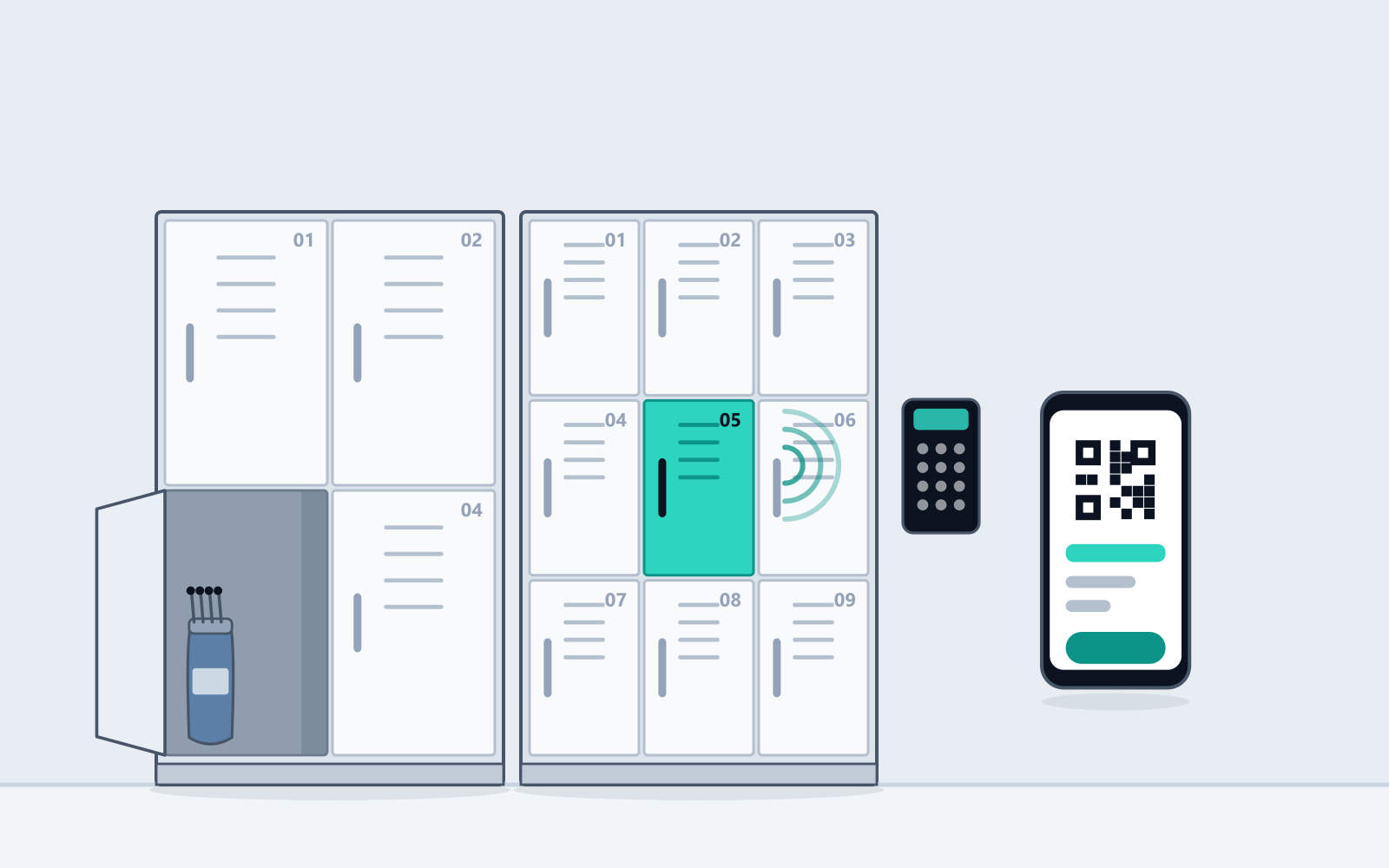
Connected access is worth comparing when the gym needs timed day-use rules, remote help for a locked-out member, or a reliable assignment and fee process for rented lockers. Latchwork’s connected tier uses a controller and a standard socket at each bank, with an annual platform subscription. The platform can set bank-level rules, keep opening records and manage access centrally; those are capabilities a standalone PIN or RFID lock does not provide.
Timed release is a policy tool, not permission to discard somebody’s property. Before enabling a closing-time rule, decide what notification users receive, who inspects a compartment, how left-behind items are recorded and where they are held. For a monthly locker, decide when a missed payment ends access and how staff will contact the member before clearing contents. The gym owns those decisions even if software applies the rule.
Decide how much of the room to reserve for monthly storage
Start with what is observable, not an assumed percentage. Count how many visitors need a temporary compartment during the busiest class changeover, and ask what regular members would actually leave on site. The first observation sizes the day-use pool; the second tells you whether an assigned offer is worth creating. Do not convert a large share of the room to monthly rental before demand is evident: every permanently assigned door is one less door available at peak time.
If there is interest, a small separate bank is easier to test than changing the rules on existing day lockers. Its dimensions should follow the items—shoes and a small kit bag, or a hanging uniform—not the spare gap on a wall. Latchwork’s assigned member lockers cover taller configurations and locks for stable as well as frequently changing memberships. For existing sound steel banks, a lock retrofit may be worth pricing before new cabinets; the sample door still needs a fit check.
Give suppliers an operating brief they can price
Send a short brief with your peak simultaneous users, the number of sites, photographs and rough dimensions of the existing room, a typical day-use bag and the largest item a monthly renter would leave. State whether visitors receive keys today, whether day lockers are being occupied overnight, and whether staff currently bill or assign lockers manually. Finally, specify the desired clearance and lost-property process rather than asking only for “smart lockers”.
Ask for day-use and assigned banks as separate lines on one drawing, with a simple lock and a connected option where the operations warrant it. That lets the gym compare the actual cost of solving each problem. The quotation form is the next step once the two user groups and their storage rules are clear.
Where this applies
Quick answer: Should a Singapore gym offer day-use lockers, monthly rental lockers or both?
Most gyms should separate short-visit storage from lockers that members keep between visits. Use high-density day-use banks near the changing area for clothes and bags, with a clear end-of-visit rule. Offer a smaller assigned bank only if members actually want to leave shoes or kit at the gym. Standalone PIN locks remove key handling but cannot clear an occupied locker automatically. Connected access is worth specifying when day lockers need timed release, monthly assignments change often or locker fees must be collected and access revoked centrally.
- Day-use lock
- PIN if keys are the problem
- Timed release
- Connected access
- Monthly rental
- Assigned compartment
- Layout
- Specify each bank by use
Questions people also ask
Can one gym have both day-use and assigned monthly lockers?
A gym can put day-use compartments and assigned monthly compartments in separate banks in the same room. Latchwork specifies the compartment layout and lock by bank, so short-visit storage does not need the same access policy as member kit storage.
Will a battery PIN lock clear a day-use locker at closing time?
A standalone battery PIN lock has no central clock or opening record, so it cannot release a day-use compartment on a closing-time schedule. Connected access supports timed rules; the gym still needs a written process for any belongings left inside.
Do monthly rental lockers require connected smart access?
Monthly rental lockers do not inherently require connected access. A small, stable assigned group can be managed with keys or offline PINs and a manual billing process. Connected access becomes useful when assignments, payments or access rights need frequent central changes.
Which compartment size should a gym choose for each type?
Day-use gym lockers can use denser changing-room banks when members only store clothing and a small bag during a session. Assigned lockers for shoes, kit or hanging items need clear dimensions matched to those items; a sample bag is more useful than choosing only by door count.
Can an existing gym locker room be converted instead of replaced?
Sound steel lockers may be candidates for a lock retrofit, but the door thickness, cut-out and latch alignment must be surveyed first. Latchwork can compare a battery keypad retrofit with connected access; worn or undersized cabinets may still need replacement.