A hybrid office should not choose between assigned and day-use lockers as if the whole floor has one storage habit. The useful question is which belongings must stay overnight, which arrive and leave with the employee, and which need a controlled handover. In most offices, the answer is a mix.
Day-use compartments support hot desks because one locker can serve different people on different days. Assigned compartments support roles that keep shoes, uniforms, specialist equipment or ergonomic accessories at work. A separate secure cabinet may be the better answer for pooled laptops, tablets, keys or confidential records.
Day-use lockers follow attendance, not employee headcount
Size shared lockers from the busiest normal day in the office. A company with a large payroll but a much smaller peak attendance does not need one day locker for every employee, because each empty compartment returns to the pool after use.
Start with evidence rather than a generic locker-to-desk ratio. Count simultaneous attendance by day and team, note visitor demand, and record what people actually bring. The peak matters more than the weekly average: a floor that is quiet on Friday can still run out of storage every Tuesday.
Add a modest operating margin instead of filling the last millimetre of wall. The spare capacity covers visitors, project teams and the occasional company-wide day. If the connected platform is used, occupancy reporting then shows whether another bank is justified. The wall planner can test how the proposed compartment size and count fit the available run before a quotation drawing is prepared.
Assigned lockers are for belongings that stay overnight
An assigned locker belongs to one person for a defined period. It is the right choice when an employee leaves shoes, a uniform, personal protective equipment, a specialist keyboard or other work kit in the office between visits.
Assigned storage is predictable: one holder needs one compartment. That simplicity is also its cost. A compartment remains unavailable when its holder works from home, takes leave or visits another site. Giving every hybrid employee permanent storage can recreate one-to-one desk allocation in steel.
Keep assigned lockers for roles with a real overnight-storage need. Review assignments when staff leave or change teams, and define what may be stored. The rest of the workforce can use day lockers near the shared desks.
| Workplace need | Best starting model | Why |
|---|---|---|
| Laptop bag and personal items for one visit | Day-use | The compartment returns to the shared pool |
| Shoes, uniform or specialist equipment kept at work | Assigned | The same person needs the contents next time |
| Visitor bags | Day-use, separate zone | Reception can explain one simple temporary process |
| Pooled laptops, tablets or radios | Controlled equipment cabinet | The office needs a handover, condition or charging workflow |
| HR files or sensitive records | Restricted cabinet | Named access and an opening record matter more than convenience |
The lock determines whether day use stays day use
A key can secure a compartment, but it makes a poor shared workflow. Someone must issue it, recover it and reconcile the register. The front desk becomes the locker system.
A standalone battery keypad lock removes the key. The employee chooses a code at the door, opens the same compartment later and leaves it available when finished. This is often enough for a smaller office where forgotten or occupied lockers are rare. It needs no wiring, socket, network or subscription, but administration happens at each door and there is no central access history.
Connected access solves a different problem. Staff can claim a compartment from a phone or at the bank, and the office can set a release rule for closing time or after a fixed duration. The system can notify the user first, show which compartments remain occupied and provision or revoke staff centrally. Each bank needs one standard 3-pin socket; it can connect over 4G, so the project does not have to depend on office network cabling or firewall approval.
The office lock comparison sets out keyed, keypad, RFID and connected options side by side. A sensible specification pays for connectivity only where automatic release, central administration or an access log solves a real problem.
Size the compartment from what goes inside
Locker count and compartment size compete for the same wall. Small cells create more doors, but they do not help if a laptop bag will not fit.
Make a short list of the largest everyday items and measure them in their cases. Latchwork’s large steel range covers clear compartment sizes from 400 × 400 × 500 to 600 × 600 × 600 mm for bags and larger day-use belongings. Small compartments, from 80 × 80 × 200 to 200 × 200 × 200 mm, are intended for phones, keys, wallets and access cards rather than bags or clothing. Final dimensions and door count belong on the quotation drawing, not in an assumption made from a catalogue photograph.
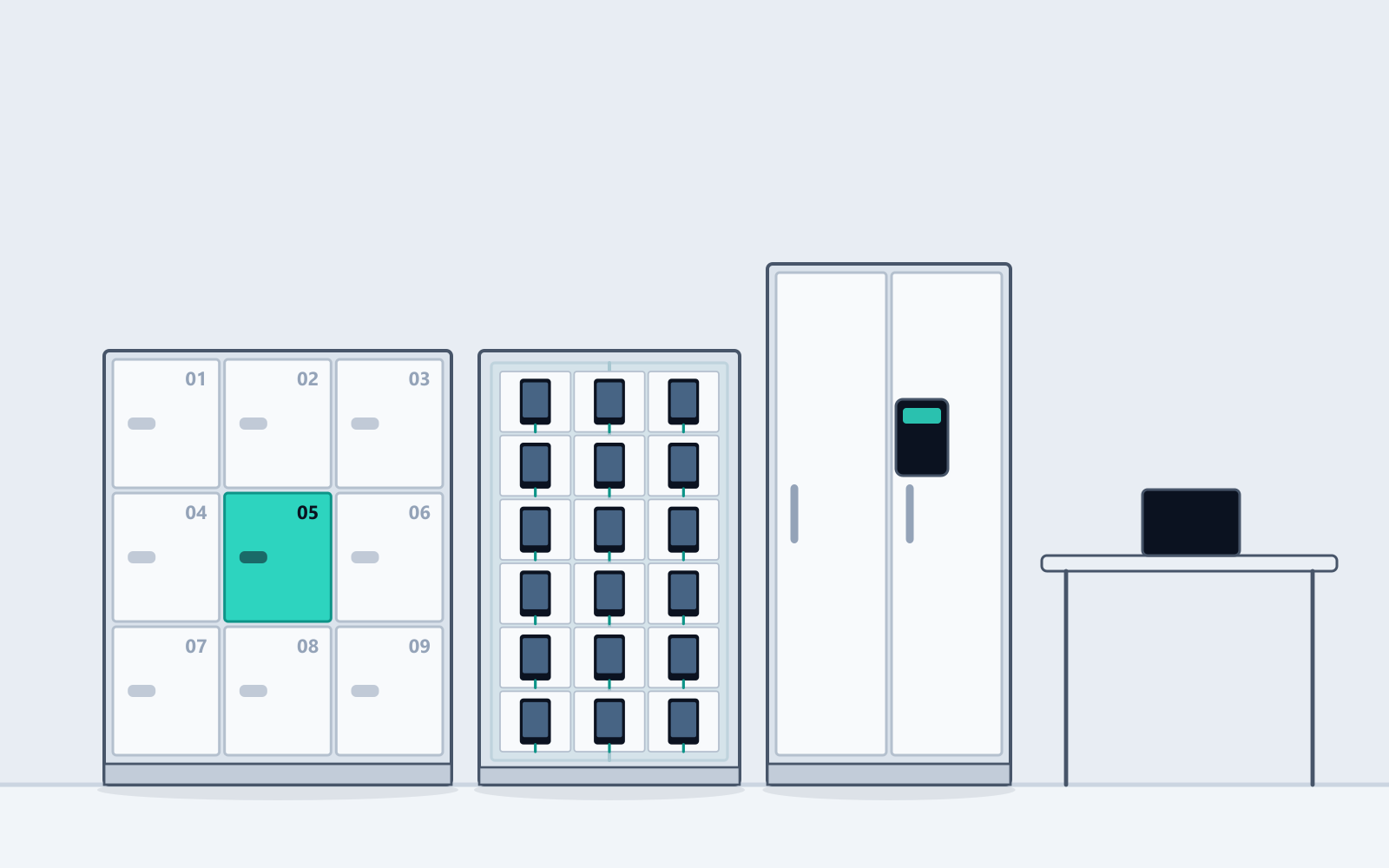
The reference illustration above shows the three zones an office commonly needs: shared lockers beside hot desks, device storage, and a more tightly controlled document cabinet. It is a planning example rather than a photograph of a completed client site. The useful lesson is the separation of workflows: personal day storage, pooled equipment and confidential records should not be forced into one bank with one access rule.
A mixed office locker plan is usually the durable answer
A practical first layout divides storage into four groups:
- Shared day-use lockers near the hot-desk area, sized from peak attendance.
- A smaller assigned bank for staff who leave genuine work kit overnight.
- Temporary visitor compartments near reception or the arrival route.
- Restricted cabinets for devices, keys or records, with the access control those assets require.
This keeps the everyday process simple without pretending every item has the same risk. It also lets the office change one group later: add a day-use bank if utilisation rises, reduce assigned storage at the next allocation review, or connect only the controlled cabinets.
Before ordering, run a two-week count of peak attendance and ask employees what they would actually store. Measure the largest bag, confirm the available wall and nearest socket, and decide what happens to a day locker still occupied at closing. Those four answers are enough for Latchwork to turn the idea into a compartment schedule and quotation drawing through the office locker enquiry page.
Where this applies
Quick answer: Should a hybrid office use assigned lockers or day-use lockers?
A hybrid office should use day-use lockers for staff who carry their belongings home, assigned lockers for people who genuinely need permanent storage, and a small separate provision for visitors or specialist equipment. Day-use lockers should follow peak attendance rather than total headcount and must release reliably after use. Assigned lockers are simpler but need one compartment per holder. Most workplaces therefore need a mixed room, not one rule for everyone.
- Day-use sizing
- Peak attendance, not headcount
- Assigned sizing
- One compartment per holder
- Keypad power
- Battery only
- Connected bank
- One 3-pin socket
Questions people also ask
How many day-use lockers does a hybrid office need?
A hybrid office should size day-use lockers from measured peak simultaneous attendance, then add a modest operating margin for visitors and unusually busy days. Total employee headcount is the wrong starting point because the same day-use compartment can serve different people across the week.
Can office day lockers use standalone keypad locks?
Standalone battery keypad locks work well where employees set a code for one visit and clearing an occupied locker is an occasional staff task. They need no socket, network or subscription, but they cannot release automatically or produce a central access log.
When does an office need connected smart lockers?
Connected smart lockers earn their cost when the office needs automatic end-of-day release, central staff provisioning, occupancy reporting or a record of who opened a compartment. Each bank needs one standard 3-pin socket and can connect over 4G without using the office LAN.
What size office locker fits a laptop bag?
A laptop bag normally needs a large rather than small-item compartment, but the correct size comes from measuring the actual bag at its widest and deepest points. Latchwork large steel compartments range from 400 × 400 × 500 to 600 × 600 × 600 mm.
Should every employee receive an assigned locker?
Every employee needs an assigned locker only when everyone must leave belongings at work between visits. Giving permanent compartments to staff who carry everything home reproduces one-to-one desk allocation in another form and removes much of the space benefit of hybrid working.