RFID Tool Lockers: Does Badge Access Track Each Tool?
An RFID badge can identify who opened a tool cabinet, but not necessarily which tool left. Compare badge access, tagged inventory and per-cell control.
By Latchwork Published 5 min read
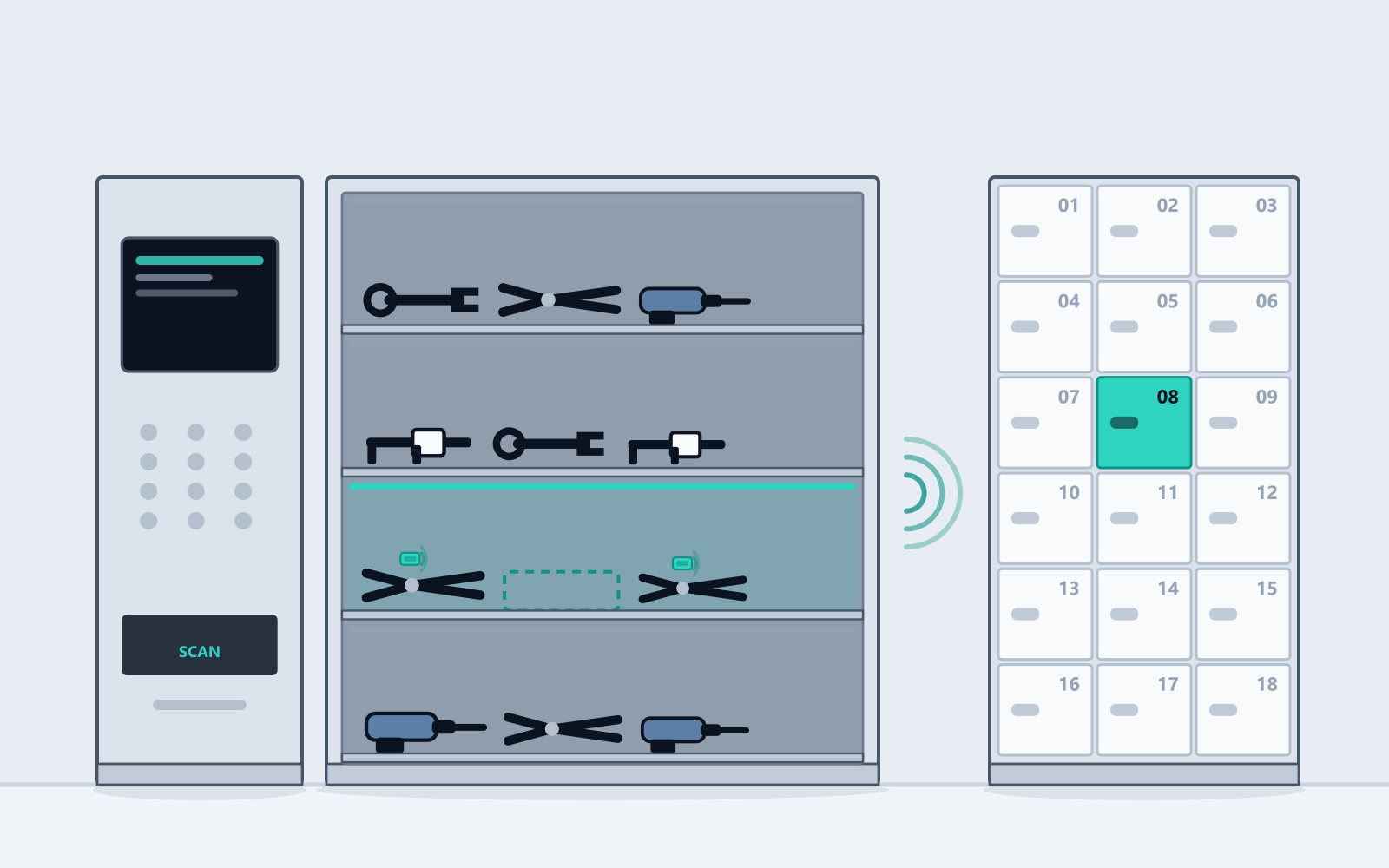
An employee tapping a card at a tool cabinet tells you who opened it. It does not necessarily tell you which torque wrench, drill or test meter left. For a Singapore workshop buying an unattended tool crib, that distinction decides whether the system will replace a sign-out counter or merely replace its key. Specify the user record and the item record separately, then test how they are joined.
Three records answer three different questions
The first record is a person: a compatible badge, PIN or QR sign-in identifies who requested access. The second is an opening: a connected latch records the cabinet or compartment and the time. The third is an item: a tagged tool, or an item assigned to its own controlled cell, shows what was removed or returned. A buyer who asks only for “RFID access” may receive the first two without the third.
| What the buyer needs to know | Badge-operated door only | Tagged inventory or dedicated cell |
|---|---|---|
| Who opened the cabinet? | The authenticated user, if access is connected and logged | The same user record |
| Which tool left? | Not established by the badge or door event | Determined from the item read or the mapped cell, subject to a successful check |
| Was it returned? | A second opening does not prove the item came back | Compare the next inventory or the agreed return event |
| What needs testing? | Card compatibility and access permissions | Tags, reader coverage, tool mapping and exception rules as well |
The distinction also separates ordinary standalone RFID locker locks from a connected tool-management project. A standalone card lock can be convenient for a small, staff-controlled store, but it does not produce a central tool ledger. Even a connected access log does not, by itself, say which of several tools on a shared shelf was taken.
Start the design from an asset list, not a cabinet drawing
List every durable tool with an identifier, dimensions, weight, storage position and owner. Mark which items need charging, which are calibrated, and which may be issued only to an approved group. Keep consumables such as blades and gloves on a separate list: they are dispensed and used, not overdue when they fail to return. The list determines whether the cabinet needs shelves, drawers, individually locked cells or a mix.
Latchwork’s made-to-order RFID tool-management range describes tagged shelves, drawers and per-cell options. In its proposed shelf workflow, a worker signs in, a door opens, and the antenna reads the compartment when it closes. A change from the prior item list becomes a proposed issue or return associated with that user. This is not a claim that every workshop tool is automatically readable: the actual tools, tag positions and metal around a shelf decide whether the item record is dependable.
For metal tools, specify an appropriate on-metal UHF tag and its attachment method. A loose adhesive label that detaches in oil, coolant or repeated handling is not an asset-control plan. A small instrument or a dense cluster of steel may be better in a dedicated cell, where the controlled door and item assignment carry the record. Agree what happens when a tag is unreadable, damaged or newly replaced; otherwise the shortage list can report a phantom loss.
Describe issue and return as a complete shift workflow
Write down what the next user sees when an item is already out, what a supervisor sees when it is overdue, and who corrects a misread. A useful transaction identifies the person, item, cabinet, time and action. The site also needs a way to handle a borrowed tool returned to the wrong shelf, a tool taken for repair, and a tag whose identifier no longer matches the asset register. Do not use an unlocked door event as a substitute for a confirmed item event.
If the cabinet must keep working during a network outage, include that in the brief. Latchwork’s tool-crib description provides local sign-in, inventory reads and queued events that synchronise when the link returns; centrally changed permissions may have to wait for the connection. Test that behavior with the proposed configuration. For a calibrated instrument, agree whether an expired item is physically withheld in its own cell or merely refused on a shared-shelf sign-out list and flagged to staff. Those are different controls.
The neighbouring problem of pooled scanners and radios is more about charging and shift readiness than tool-tag inventory. The shared-device charging guide covers that workflow. Do not turn every powered device into an RFID tool project unless identifying the individual item is genuinely required.
Make a small, difficult pilot the acceptance test
A convincing demonstration uses the actual tool mix, including the awkward items, not a clean row of sample tags. Ask the supplier to walk through the following sequence before approving a full bank:
- Sign in with an authorised worker and a real site credential; try an unauthorised one too.
- Remove two tagged tools from one shelf and return only one. Check the person, item and time recorded for each action.
- Put an item on the wrong shelf, hide one tag behind metal and present a damaged or replaced tag. Agree how exceptions are investigated rather than silently accepted.
- Try a tool that is past its calibration date and a consumable that is not expected back. Verify the two policies produce different outcomes.
- Disconnect the network during an issue, restore it, and confirm the locally recorded event reaches the central list once—not zero times or twice.
Record pass/fail criteria for the pilot, including which tools are unsuitable for shelf reads and need another storage method. The contractor specification guidance can help turn that into a schedule alongside compartment sizes, power and installation constraints. A site manager should also own the asset register after commissioning: new tools must be tagged and mapped, and exception reports need someone to act on them.
Send Latchwork the tool schedule, photographs of the hardest items, expected user groups, any existing badge sample and the proposed issue-and-return rules through the quotation form. Ask for a small pilot and an item-level acceptance record. The right purchase is the one that can reliably answer who has tool 14 now, not just who last opened the cabinet.
Where this applies
Quick answer: Does an RFID staff badge tell us which tool left a locker?
An RFID staff badge identifies the person admitted to a tool cabinet; it does not, by itself, identify the tool removed. Tool-level tracking needs a second observation: for example, a suitable tag on each item read before and after the cabinet opens, or a dedicated cell whose door is mapped to one item. A Singapore workshop specifying an unattended tool crib should ask the supplier to demonstrate the complete sign-in, issue, return and exception record with its actual tools, not accept a badge reader as proof of inventory control.
- Staff badge
- Identifies the person at entry
- Tool tag
- Identifies an individual item
- Door event
- Proves access, not contents
- Acceptance test
- Use the site’s actual tools
Questions people also ask
Is an RFID card lock the same as an RFID tool-tracking cabinet?
An RFID card lock checks a compatible user credential to open a door. An RFID tool-tracking cabinet additionally needs item tags, readers and a workflow that compares contents before and after access. A card-opening record alone cannot prove which tool a worker took.
Can a tool cabinet track items without staff scanning each one?
A suitably configured RFID tool cabinet can read tagged items in a compartment when its door closes and compare that inventory with the prior reading. Latchwork describes this as a made-to-order tool-crib workflow; buyers should test tag placement, antenna coverage and exception handling with their actual tool mix before acceptance.
Will ordinary RFID labels work on metal tools?
An ordinary RFID label should not be assumed to read reliably when fixed to a metal tool. Latchwork specifies on-metal UHF tags and tunes the reader against the real shelf layout; a difficult-to-tag item may need a dedicated compartment or another agreed identification method. Prove the reading with the actual tools.
How should shared consumables be recorded?
Consumables such as blades or gloves should be defined as issued quantities, not overdue returnable tools. A tool-crib brief should separate consumable dispensing cells from tagged durable assets so the shortage list does not treat a correctly used item as missing.
What happens if the network fails during a shift?
A proposed Latchwork connected tool crib is designed to continue local sign-in, opening and inventory reads during a network outage, then synchronise queued events. The buyer should include an outage-and-recovery test in acceptance and agree how centrally changed permissions behave until the connection returns.