How Many Gym Lockers Do You Need at Peak Class Changeover?
Size day-use lockers for a Singapore gym or studio by counting simultaneous users at class changeover, then check unavailable doors, bag fit and room layout.
By Latchwork Published 5 min read
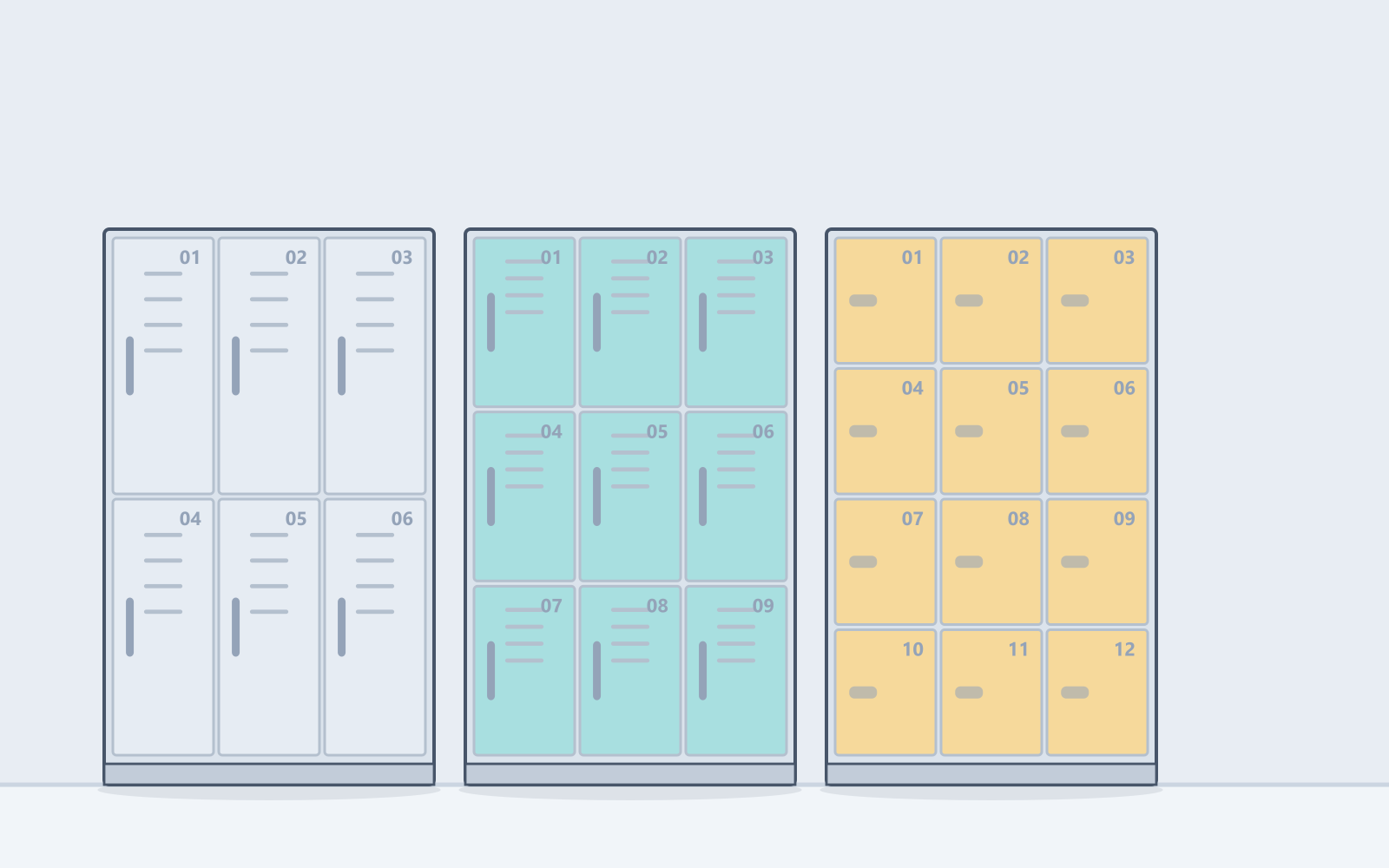
The number of day-use lockers a gym needs is a peak simultaneous-use question, not a membership-count question. A studio can have a modest class size and still run short when an arriving class asks for lockers before the departing class has collected its things. Count that overlap first; only then turn the count into cabinets.
Measure the overlap, not the day’s total visits
Watch the busiest changeover from before arrivals begin until the last departing member has emptied a locker. Record how many people actually need a door at each point in that window. Repeat on a few representative busy days, including any schedule with two rooms changing classes together. A headcount at the start of one class misses the doors that are still in use by the previous class.
Make a simple timestamped tally. Count departing members whose belongings remain in lockers, arriving members who now need a compartment and other users already on the gym floor or in the changing area. Count people seeking storage, not everyone walking through reception. Members who arrive ready to exercise or carry their bag with them may not need a door; members with a coat and work bag may need a larger one. Record what you see rather than imposing a universal percentage.
| Group at the same moment | Include in the day-use demand? | What to observe |
|---|---|---|
| Departing class | Yes, while their lockers remain occupied | Time between class end and collection |
| Arriving class | Yes, when they need a locker before class | How early members arrive and change |
| Open-gym or other-class users | Yes, if they need temporary storage | Other activity during the same interval |
| Monthly assigned members | No; their doors are reserved separately | Number of paid or allocated doors |
| Staff storage | No; plan its own capacity | Shift overlap and uniform storage |
The table is also a useful way to brief a supplier. It prevents an attractive drawing with the correct total number of doors but too few available to visitors. Latchwork’s gym and studio solutions distinguish temporary day use from longer-term assigned storage for this reason.
Turn observations into a working door count
Add the groups that overlap at the busiest observed moment, then account for doors that cannot be offered. Suppose a particular studio records 18 outgoing members still holding lockers, 16 arriving members needing lockers and 7 other day users at one changeover. That is 41 simultaneous day-use doors in this illustrative calculation. If three doors are intentionally switched off or out of service, the room needs at least 44 physical day-use doors to offer 41 working ones. These figures are an example of the method, not a recommended ratio or a claim about a typical Singapore studio.
Do not treat the example as a promise that 44 doors will work at every future timetable. Compare several busy intervals, note special events and planned class-size changes, and decide what practical spare capacity your own service policy requires. If the space is tight, there is a real trade-off between the occasional queue and adding another bank. Show that trade-off on a layout rather than hiding it inside a round-number estimate.
Keep an availability log for broken locks, doors awaiting repair and compartments held for cleaning or lost-property handling. A locker that exists on the drawing but cannot be issued does not satisfy peak demand. Recheck the count after the opening period: actual use is more informative than the initial programme once members settle into their routines.
Keep reserved doors out of the day-use pool
A monthly locker is unavailable to casual users even when its member is not in the building. Staff lockers may likewise be occupied across shifts. Split the schedule into day-use, assigned-member and staff rows before deciding how many banks to order. If the gym wants to test monthly rental, start with a clearly separate bank so a reserved door does not silently shrink the day-use capacity.
The day-use versus monthly rental guide covers the different access and clearance rules. For this sizing exercise, the important point is simpler: one physical door can serve only one operating pool at a time. A future change of use should trigger a fresh peak count and a visible relabelling of the affected bank.
Translate doors into a room that people can use
Choose the compartment around the items members bring, not the largest door count printed on a catalogue page. Latchwork’s changing-room locker configurations range from tall, low-density doors to more compact 12-, 18- and 24-door banks. A denser bank can fit more users along a wall, but it is a poor answer if a normal work bag cannot be placed inside without forcing the door. Take a representative bag, shoes and clothing to the site survey and check the clear usable opening.
Then measure the available wall run, ceiling, door swings and the space people need to pass and change. A bank placed where every opening blocks the main path may create a queue even when the door count is technically sufficient. The wall planner is a useful first pass for matching a target count to an opening; a final drawing still needs a site check for access, cleaning and installation.
If the current steel banks are sound, include their usable doors in the schedule before pricing new cabinets. A lock upgrade can sometimes remove the key-desk problem without replacing the whole room. Latchwork checks a sample existing door for latch geometry and thickness before recommending a retrofit; visual similarity between two lockers is not proof that the same lock will fit both.
Match access control to the problem you measured
A standalone battery keypad lets a day user set a session code and leaves no key to issue at reception. It needs no bank wiring or platform subscription. It does not, however, tell staff which doors are occupied centrally or release a door automatically at closing. If the measured shortage is caused by doors being held overnight, a more efficient layout alone will not solve it.
Connected access is worth evaluating when the operator needs scheduled release, central visibility or paid assigned lockers. Those features come with a powered controller and platform subscription, so they should be justified by an operating need rather than added to every bank by default. Whichever access method is chosen, define who can open a forgotten locker, how a member is contacted and how property is documented before a door is cleared. A capacity plan depends on that process actually returning doors to service.
For a quotation, send the peak timestamped counts, the separate reserved-door totals, a sample bag, photographs and measured wall dimensions. Ask for a layout showing working day-use capacity, not just the gross number of compartments, and compare at least one compact and one larger-door mix. Latchwork can turn that brief into a site-specific locker quotation and flag where a sample-door or site survey is needed.
Where this applies
Quick answer: How many day-use lockers does a Singapore gym or fitness studio need?
A Singapore gym or fitness studio should size its day-use locker pool for the greatest number of people who need a compartment at the same time, especially when one class is leaving and another is arriving. Count outgoing members still holding lockers, incoming members who need one and other gym users present during that overlap. Keep monthly assigned lockers and staff storage out of the available day-use count, allow for temporarily unusable doors, then check that the chosen compartments fit real bags and the banks fit the room.
- Count
- Simultaneous locker users
- Peak window
- Class arrival and exit overlap
- Separate pool
- Monthly and staff lockers
- Verify
- Bag fit and room circulation
Questions people also ask
Should a gym provide one locker for every member?
A gym does not normally size day-use lockers from its total membership list. The useful count is the highest number of members who need a temporary compartment simultaneously, including the overlap between outgoing and incoming classes. Permanently assigned lockers are counted separately because they cannot be offered to the next visitor.
Do two back-to-back fitness classes need two full sets of lockers?
Back-to-back fitness classes need capacity for the people from both classes who hold or seek a locker during the same minutes, not automatically two complete class capacities. Observe how long departing members keep their doors and when arriving members start using theirs; add other users in the changing room during that interval.
Can a studio count monthly rental lockers as spare day-use capacity?
Monthly assigned lockers should be reserved for their holders, even when the members are away. A studio that counts those doors as available for day use risks promising the same compartment to two people. Put day-use, assigned-member and staff doors in separate lines of the capacity schedule.
Is a 24-door bank always the best way to meet a locker target?
A 24-door changing-room bank provides more compartments per cabinet than a lower-density layout, but door count alone does not prove that members’ bags fit. Latchwork offers changing-room banks in different compartment layouts; test a representative bag and check clear door dimensions, wall space and circulation before choosing the mix.
What if lockers are still occupied after closing?
A locker occupied beyond its intended day-use period is unavailable to the next member until staff follow a clear-property process. Standalone battery keypads remove key handling but do not release doors on a schedule. Latchwork can discuss connected access with timed-release rules where persistent overnight occupation is the actual operating problem.