Forgotten Gym Locker PIN: How Should Staff Restore Access?
A safe forgotten-PIN process for Singapore gym lockers: verify the claim, use an authorised override, record the opening and reset the door.
By Latchwork Published 5 min read
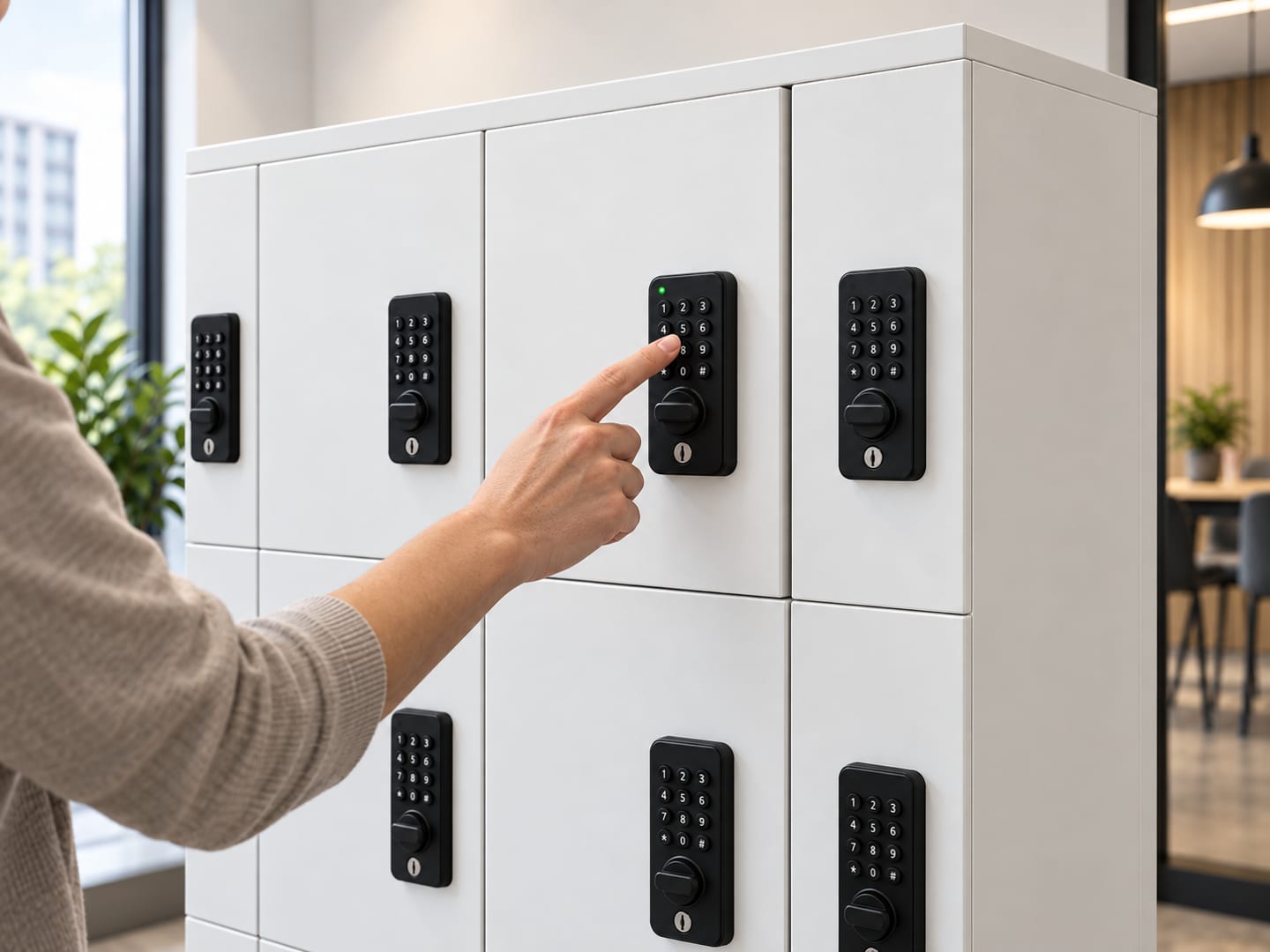
A forgotten locker PIN is a routine service issue, but opening the wrong compartment for the wrong person is a serious one. The safest gym procedure separates claim verification from technical release. A master key or remote button solves only the second step; neither proves that the person asking owns what is inside.
Verify the claim before anyone overrides a door
Ask the member to identify the locker number and describe when they used it and what they expect to retrieve. Check the claim against the gym’s membership or check-in process and any available assignment record. A day-use locker may have no named assignment at all, so staff should not treat possession of a membership card as proof that a particular door belongs to that member. If the details conflict, escalate to the duty manager instead of trying several doors.
Keep the conversation discreet. There is no reason to ask a member to announce a private PIN at reception or to show other members the contents of an open locker. Before a recovery, decide who may authorise it, whether another staff member should witness it, and how the action will be recorded. Those are gym operating rules, not features a lock can supply automatically.
The same check matters for an assigned monthly locker, although the assignment list offers an extra way to corroborate a claim. The day-use versus monthly rental guide explains why the two banks need different allocation and clearance policies.
Use the approved recovery path for the lock fitted
Latchwork offers different access arrangements for changing rooms. A standalone battery keypad is managed at the individual door: authorised staff hold a programming card and mechanical override key, and codes are reset locally. There is no network, central locker list or remote-release button. An operator planning an unattended gym must therefore decide who can reach the site if a member is locked out outside staffed hours.
A connected bank can support a release by an authorised manager from a phone or console and keeps an opening record. That can reduce the time to help a late-night member, but it does not establish ownership of the items. The manager still needs the verification step and a way to identify the exact door. Connected access requires a controller, power at the bank and a platform subscription; it is a different operating decision, not a setting hidden inside an offline keypad.
| Recovery decision | Standalone battery keypad | Connected Latchwork access |
|---|---|---|
| Where staff act | At the locker door | Authorised remote release or local override |
| What staff hold | Programming card and master override key | Authorised console access; mechanical override remains available |
| Central opening record | No; keep a manual incident log | Platform opening log; add context to the incident record |
| Forgotten PIN outside staffed hours | An authorised person must attend | Remote help may be possible if the service process is staffed |
| Code or access reset | At the individual lock | Through the configured access workflow |
The access options comparison shows which capabilities belong to each tier. Do not tell staff that “digital” means “remotely manageable”: a door-mounted battery keypad and a controller-backed connected latch may look equally modern to a member, but their recovery paths differ.
Open, document and return the locker to service
Once the claim is sufficiently checked, an authorised staff member should use the approved override for the installed lock. Record the door number, approximate time, claimant, staff authoriser, reason for opening and whether belongings were collected. If the door was opened remotely, the system’s opening log helps establish when an access event occurred; the gym’s incident note still explains why it happened and what staff observed. A standalone lock has no central audit record, so that manual note matters even more.
Allow the member to retrieve their own belongings where practical, without an unnecessary inspection or public display. If the member cannot be verified, or staff find items inconsistent with the claim, pause and follow the gym’s disputed-property procedure rather than handing over the contents on the strength of a guessed PIN. The precise escalation and lost-property rules should be written before the first incident, not invented at the open door.
For a day-use keypad, reset the old code at the door after the member is finished and test that the lock is ready for a new user. For a fixed assigned code, confirm the current holder and change access in the assignment process rather than treating the locker as free. A door with a flat battery, failed latch or uncertain state should be marked unavailable until repaired and tested. Every Latchwork-fitted compartment has a mechanical master override, so a power problem should not trap a member’s belongings, but it can take that door out of normal service.
Design the policy before choosing hardware
If forgotten codes are occasional and staff are present whenever lockers are used, standalone keypads may be the simplest answer. Members choose a day-use PIN and there are no keys to hand out at the desk, no wiring and no platform subscription. The trade-off is that each exceptional reset is handled locally. That may be perfectly acceptable for a single staffed studio.
If the club opens when no authorised key holder is on site, map the real assistance window. Will a duty manager be reachable? Can they verify the member without being present? Is a remote release appropriate for the value and sensitivity of the contents? A connected bank may make operational sense where central help, changing assignments, timed rules or opening records are required. It should not be bought solely because a PIN might be forgotten once in a while.
The policy also affects capacity. A door awaiting a reset or repair is not a usable day locker during class changeover. Keep a simple unavailable-door count and compare it with the peak-use calculation in the gym locker sizing guide. A technically adequate room can still feel short of space when several doors are left out of service.
Put the recovery procedure in the project brief
Ask a prospective supplier to demonstrate a forgotten-PIN recovery on a sample door, including a flat-battery case. Confirm exactly which staff credentials are issued, how they are stored, what happens when an authorised employee leaves and what the chosen lock records automatically. For a connected option, demonstrate the remote-release permissions and the opening history rather than relying on a feature list. For an offline option, practise the local reset and identify the person who can attend outside reception hours.
Send Latchwork the number of doors, whether they are day-use or assigned, the gym’s staffed hours and photographs of any existing banks. We can compare a keypad retrofit with a connected arrangement against the same changing-room locker configuration, then provide a quotation that makes the recovery responsibilities visible rather than leaving them for opening day.
Where this applies
Quick answer: What should a Singapore gym do when a member forgets a locker PIN?
When a gym member forgets a locker PIN, staff should verify the claim to that specific door before an authorised override, record who opened it and why, and reset the door after the member retrieves their belongings. Latchwork standalone battery keypads need staff at the door with the approved override; connected lockers can support an authorised remote release and retain an opening log. Neither lock type proves who owns the contents, so membership and property checks remain the gym’s responsibility.
- First check
- Claim to the specific door
- Offline recovery
- Staff override at the door
- Connected option
- Authorised remote release
- After opening
- Record and reset the door
Questions people also ask
Can staff open a Latchwork keypad locker if the member forgets the code?
Latchwork standalone keypad lockers have a staff-held programming card and mechanical master override. An authorised staff member can recover a forgotten-code locker at the door, subject to the gym’s own identity and property-handling procedure. The user’s code should then be reset before the compartment is offered again.
Can a standalone keypad locker be opened remotely?
A standalone battery keypad locker cannot be released remotely because it has no network or central console. Staff must attend the door with the approved local override. If a gym needs late-night remote assistance, it should compare connected access rather than assume a keypad lock has that function.
Does the locker system prove who owns the belongings inside?
A locker opening record does not by itself prove ownership of the contents. The gym should verify the claimant using its membership and locker-use process before an override, avoid displaying contents unnecessarily and record who authorised and witnessed any exceptional opening.
What if a keypad locker battery is flat as well as the PIN being forgotten?
A flat battery does not trap belongings in a Latchwork-fitted locker because each compartment has a mechanical master override. Staff should use the authorised key, replace the battery or repair the lock as needed, and test the door before putting it back into day use.
Should a gym post its master override code at the reception desk?
A gym should keep override credentials under controlled staff custody, not post or share them as general member instructions. The recovery checklist should name who may open a door, how the claimant is verified and where the action is recorded; the exact lock procedure belongs in restricted staff training.